






Chand Baori, Rajasthan: Labyrinth of Light
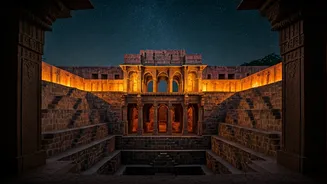
Located in the village of Abhaneri, Chand Baori is one of India's most dramatic and visually stunning stepwells. Its 3,500 narrow steps, arranged in perfect symmetry, descend 13 stories into the earth. During the day, it’s a dizzying spectacle of geometry.
At night, it transforms into a profound study of light and shadow. While public access after dark is restricted, the annual Abhaneri Festival often features cultural performances that illuminate the structure beautifully, providing a rare and sanctioned opportunity for night photography. Outside of festival times, photographers must seek special permission from the authorities. A successful night shoot here isn't about simply showing up; it requires planning. The reward, however, is capturing the stark, repeating patterns of the steps as they create an almost surreal, M.C. Escher-like effect under controlled lighting or a full moon. Its proximity to the Jaipur-Agra highway makes it a fantastic anchor point for a Rajasthan road trip.
Adalaj Stepwell, Gujarat: An Illuminated Wonder
Just a short drive from Ahmedabad, the Adalaj Vav is one of the most accessible and well-preserved stepwells in Gujarat, making it an ideal first stop on a regional road trip. This five-story-deep structure is renowned for its intricate fusion of Hindu and Islamic architectural styles. What makes Adalaj particularly suited for night photography is that it is often beautifully and professionally lit after sunset. The soft, warm lighting highlights the ornate carvings on the pillars, balconies, and walls without creating harsh glares. This means you can focus on composition and long exposures without needing to bring your own complex lighting setup. The symmetrical design allows for powerful compositions looking straight down from the entrance. The interplay of the artificial light with the deep shadows in the well creates a sense of immense depth and mystery. Its ease of access and reliable lighting make it a perfect, low-stress location for photographers looking to get their first taste of stepwell night photography.
Rani ki Vav, Gujarat: A UNESCO Treasure by Night
Recognised as a UNESCO World Heritage Site, Rani ki Vav in Patan is less a well and more an inverted temple, glorifying water. It is grand in scale and covered in more than 500 major sculptures and over a thousand minor ones. Photographing it at night is a quest to capture this sheer artistic density in a different mood. Like Chand Baori, night access is not standard and typically requires official permission, which is sometimes granted for professional or academic projects. However, the site is occasionally lit for special events. For those who manage to arrange a shoot, the experience is unparalleled. Using techniques like light painting—using a torch or flash to selectively 'paint' parts of the structure during a long exposure—can bring individual sculptures to life against the dark backdrop. The goal is to isolate the intricate details of Vishnu's avatars or the elegant apsaras from the overwhelming scale of the vav, creating intimate portraits of stone art that are impossible to achieve in the flat light of day.
Essential Gear for the Trip
Night photography demands more than just a camera. To do justice to these architectural marvels, your kit should be well-prepared. A sturdy tripod is non-negotiable; you will be using long shutter speeds, and any camera shake will ruin the shot. A camera with manual mode is essential for controlling ISO, aperture, and shutter speed. For lenses, a wide-angle (16-35mm range) is perfect for capturing the grand scale of the stepwells, while a prime lens (like a 50mm f/1.8) can be great for isolating details with a shallow depth of field. Don’t forget a remote shutter release or use your camera’s self-timer to avoid vibrations when you press the shutter button. Pack several fully charged batteries, as long exposures drain power quickly, especially in cooler night air. Finally, a powerful headlamp or torch is crucial not only for your own safety while navigating uneven steps in the dark but also for 'light painting' to add creative flair to your images.
Safety and Etiquette: Photographing with Respect
Exploring these ancient sites at night is a privilege, not a right. Always prioritize safety and respect. Many stepwells are in rural areas, so plan your travel and accommodation in advance. Never venture into a site alone at night; travel with a partner or a small group. Before your trip, research the access rules for each stepwell. Do not trespass. If a site is closed after hours, inquire with the local Archaeological Survey of India (ASI) office or state tourism board about the possibility of obtaining a special permit for photography. Be prepared for paperwork and potential fees. When on site, be mindful of the structure. These are delicate heritage sites. Do not climb on fragile walls or sculptures. Leave no trace behind—pack out everything you bring in. Your goal is to capture the beauty of the place, not to damage it for future generations.