



How Microwaves Make Heat
To understand the unevenness, we first have to know how a microwave heats food. It’s not like a conventional oven that uses hot air. Instead, a device called a magnetron generates microwaves, a type of electromagnetic wave. These waves are particularly
good at interacting with certain molecules, especially water. Food contains a lot of water. When microwaves pass through the food, they cause the water molecules to vibrate rapidly, flipping back and forth billions of times per second. This frantic vibration creates friction between the molecules, and that friction generates heat, cooking the food from the inside out.
The Problem of Hot and Cold Spots
The primary culprit for uneven heating is a phenomenon called “standing waves.” Inside the metal box of the oven, the microwaves don't just travel in a straight line; they bounce off the reflective interior walls. As the waves reflect and interfere with each other, they create a fixed pattern of high and low energy areas. The high-energy points are “hot spots” where food cooks quickly, while the low-energy points, or “nodes,” are “cold spots” where very little heating occurs. This interference pattern is stationary, meaning if your food doesn't move, some parts will get blasted with energy while others get barely any at all.
The Turntable's Imperfect Solution
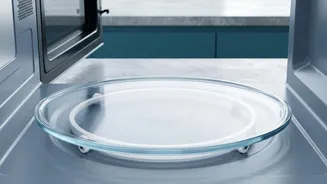
This is precisely why microwave ovens have a rotating turntable. The goal is to move the food through the various hot and cold spots, helping to average out the energy exposure and promote more even cooking. However, it’s not a perfect system. Food placed directly in the center of the turntable moves very little, while food on the outer edge travels a much greater distance. This means the center of your dish might still spend most of its time in a single spot—potentially a cold one—while the edges get more comprehensive heating. Some higher-end microwaves also use a “stirrer fan” to help distribute the waves more randomly, but the principle remains the same.
Why Food Composition Matters
Beyond the oven's mechanics, the food itself plays a huge role. Different ingredients absorb microwave energy at different rates. Foods with higher water content heat up much faster than drier or denser foods. This is why the berries in a pie can become molten while the crust is still cool, or the sauce on your pasta is boiling but the meatballs are lukewarm. Fats and sugars are also excited by microwaves, but water is the most efficient. The shape and thickness of food also have an impact. Microwaves only penetrate about an inch to an inch and a half into food; the center of a dense item like a potato or a thick piece of meat relies on heat conducting from the outer layers, which is a much slower process.
Tips for Perfectly Even Heating
Armed with this knowledge, you can outsmart the physics of your microwave. First, arrange your food in a ring or donut shape on the plate, leaving the center empty. This keeps any part of the food from sitting motionless in the middle. Second, always cover your food with a microwave-safe lid or a damp paper towel. This traps steam, which helps to distribute heat more evenly throughout the dish. Third, make it a habit to stop the microwave midway through the cooking time to stir your food or rotate the dish. Finally, let your food stand for a minute or two after the timer goes off. This allows the heat to continue distributing through conduction, evening out the temperature before you take that first bite.