



Seeing the Invisible: How Infrared Finds Water
Finding water on the Moon isn't as simple as looking for a lake. For decades, scientists suspected water ice was trapped in permanently shadowed craters at the lunar poles, where temperatures are incredibly low. The challenge was proving it was H2O and
not just hydroxyl (OH), a close chemical relative. This is where infrared technology comes in. All molecules, including water, vibrate at specific frequencies and emit or reflect radiation in a unique way, like a chemical fingerprint. NASA's Stratospheric Observatory for Infrared Astronomy (SOFIA), a telescope mounted on a Boeing 747, was able to detect the specific 6.1-micron wavelength unique to water molecules. By flying above most of Earth's atmosphere, which would otherwise block these signals, instruments like SOFIA and spectrometers on satellites can map these signatures from afar, distinguishing true water from other compounds. This technique allows scientists to create detailed maps showing the concentration of water ice mixed within the lunar soil, or regolith.
What the New Maps Reveal About Lunar Ice
Early missions confirmed the presence of hydrogen at the poles, but the new generation of infrared mapping provides unprecedented detail. In 2023, NASA released the first detailed, wide-area map of water distribution near the Moon's South Pole, created using data from SOFIA. The map showed that water is more widespread than previously thought, extending beyond the coldest, darkest craters. Intriguingly, it revealed higher concentrations on the shady, poleward-facing sides of craters and mountains. It's not a sheet of ice like a skating rink, but rather water molecules trapped within lunar glass or between grains of soil. Concentrations are estimated to be around 100 to 412 parts per million—roughly equivalent to a 350 ml bottle of water in a cubic meter of soil. While this may not sound like much, it's a significant finding that challenges our understanding of how water is created and persists on the airless lunar surface.
India's Crucial Role in the Water Hunt
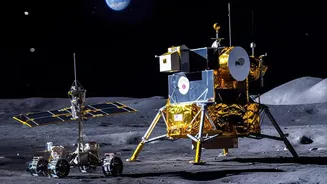
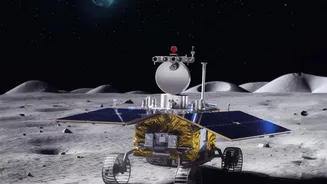
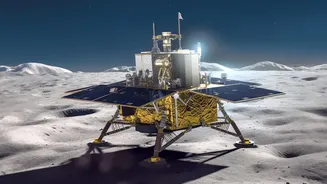
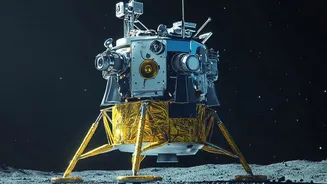
India has been a pivotal player in the quest for lunar water. ISRO's Chandrayaan-1 probe in 2009, carrying a NASA instrument, was among the first to detect water on the lunar surface. More recently, findings from the Chandrayaan-3 mission, which landed near the South Pole in 2023, have added crucial ground truth to orbital data. The lander's ChaSTE instrument provided the first-ever in-situ temperature profiles of the polar region, revealing unexpected temperature variations that influence where water ice can remain stable just below the surface. By combining radar data from Chandrayaan-1 and Chandrayaan-2, Indian researchers have also found new evidence of subsurface ice deposits, protected by layers of regolith. These findings from ISRO missions are vital, suggesting that accessible water ice may be more abundant than previously believed, a major boost for future exploration.
The 'New Gold' for a Space-Faring Future
The intense interest in lunar water isn't just academic; it's about building a future in space. Water is considered the 'new gold' because it is a critical resource for long-term human presence. It can provide drinking water and oxygen for astronauts to breathe. More importantly, it can be split into hydrogen and oxygen through electrolysis, providing the fundamental components for rocket propellant. This means future missions could potentially refuel on the Moon, making it a crucial pit-stop for deeper space exploration to Mars and beyond. Establishing a lunar base where water can be extracted, a process known as in-situ resource utilization (ISRU), would drastically reduce the cost and complexity of missions, as it would mean not having to launch everything from Earth.