



What is a Predictive AI Simulator?
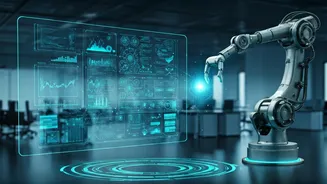
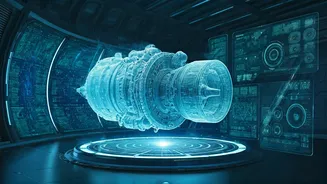
Imagine a perfect, virtual replica of a jet engine, a rocket, or even an entire aircraft, existing only inside a computer. This is a 'digital twin'. Now, imagine this twin isn't static; it can be subjected to the virtual equivalents of extreme heat, intense
pressure, and mind-bending speeds. Predictive AI simulators take this a step further. Instead of just running pre-programmed scenarios, they use artificial intelligence to analyse vast amounts of data from past experiments, material science, and fluid dynamics. The AI learns the underlying physics and can then predict how the design will behave in millions of scenarios—many of which have never been tested before. It's not just simulation; it's digital foresight, allowing engineers to spot potential failures or design flaws before a single piece of metal is ever forged.
Beyond the Wind Tunnel
For over a century, the wind tunnel has been the gold standard of aerospace testing. But it has its limits. Wind tunnels are expensive to build and operate, can only test one condition at a time, and often can't replicate the extreme environments of hypersonic flight or space re-entry. AI simulators offer a powerful complement. Engineers can run thousands of 'virtual wind tunnel' tests in a single day, tweaking wing shapes, engine intakes, and control surfaces with a few clicks. This allows them to explore a much wider design space and arrive at an optimal solution far more quickly. Physical testing isn't obsolete—far from it. Instead, it becomes the final verification step for a design that has already been perfected through countless hours of virtual validation. This drastically reduces the number of expensive physical prototypes needed, saving both time and money.
Engineering Safety at the Code Level
The single biggest advantage of these simulators is safety. In the real world, you can't afford to test an engine until it explodes just to see its breaking point. In a virtual lab, you can do it a thousand times before lunch. Engineers can simulate catastrophic component failures, bird strikes, extreme weather turbulence, and material fatigue over a 30-year lifespan—all in a matter of hours. The predictive AI can identify 'emergent' risks—unexpected problems that arise from the complex interaction of different systems—that human designers might miss. By breaking the machine virtually, over and over, they learn how to build a real one that won't. This moves safety from a feature that is tested at the end, to an integral part of the design process from the very beginning.
The Global Online Laboratory
The “online” aspect of these labs is transformative. By hosting these sophisticated digital twins on the cloud, aerospace companies can create global, collaborative environments. An aerodynamics expert in Bengaluru, a materials scientist in Toulouse, and a propulsion engineer in Seattle can all work on the same virtual prototype simultaneously. They can run simulations, analyse the results together in real-time, and make collective design decisions without anyone needing to board a plane. This breaks down geographical barriers, accelerates development cycles, and allows organisations to tap into a global pool of talent. It democratises access to high-end research tools that were once the exclusive domain of a few government agencies and corporate giants.
A Leapfrog Opportunity for India
For a nation with ambitious aerospace goals like India, this technology is more than just an interesting development—it's a strategic asset. Embracing predictive AI simulation can help organisations like ISRO and DRDO, as well as the burgeoning private space-tech sector, to accelerate their programmes. It allows for more ambitious designs, like the Advanced Medium Combat Aircraft (AMCA) or reusable launch vehicles, to be developed with greater confidence and at a lower cost. Instead of spending decades catching up on physical infrastructure, India can potentially leapfrog competitors by investing in cutting-edge digital infrastructure, fostering a new generation of engineers who design and test in the virtual world before building in the real one.