




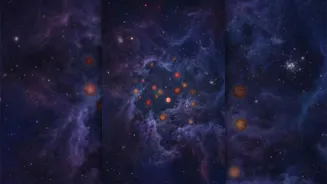

NASA's newest cosmic cartographer, the SPHEREx telescope, is on a mission to map the entire sky in unprecedented detail. This isn't just another star picture book; it's a deep dive into the chemical history of our universe.
What is SPHEREx?
SPHEREx, which stands for Spectro-Photometer
for the History of the Universe, Epoch of Reionization, and Ices Explorer, is a space observatory designed for a unique task: to survey the entire sky four times over its two-year mission. Unlike telescopes like the James Webb Space Telescope that focus on specific, narrow targets, SPHEREx is a wide-angle surveyor. Its goal is to create a massive, 3D map of the cosmos by capturing data on hundreds of millions of galaxies and over 100 million stars within our own Milky Way. Launched in early 2025, this mission will provide astronomers with a comprehensive dataset to tackle some of the biggest questions in science.
Seeing the Universe in Infrared
The human eye can only see a small fraction of the light that exists, known as the visible spectrum. SPHEREx, however, sees the universe in near-infrared light. This is crucial because many cosmic objects, like newly forming stars and distant galaxies, are shrouded in thick dust clouds that visible light cannot penetrate. Infrared light passes through this dust, allowing scientists to see what lies within. Furthermore, as the universe expands, light from the most distant—and therefore, oldest—galaxies gets stretched into longer, redder wavelengths. By observing in the infrared, SPHEREx can effectively look back in time to the early universe.
A 'Mantis Shrimp' with 102 Colors
The headline feature of SPHEREx is its ability to see the sky in 102 different infrared 'colors' or wavelengths. This is a massive leap from previous all-sky surveys and has led some involved in the mission to compare its vision to that of a mantis shrimp, an animal with one of the most complex visual systems on Earth. This technique, called spectroscopy, works like a prism, splitting light into its component wavelengths. Each chemical element and molecule absorbs and emits light in a unique pattern of wavelengths, creating a 'chemical signature' or fingerprint. By analysing these 102 spectral bands, scientists can determine the composition of everything the telescope sees, from distant galaxies to nearby stellar nurseries.
Answering Three Big Questions
The mission has three primary scientific goals. The first is to understand the Big Bang's immediate aftermath by studying cosmic inflation—the period of ultra-fast expansion in the first fraction of a second of the universe's existence. The patterns in how galaxies are distributed across the sky hold clues about this event. Second, SPHEREx will study the history of galaxy formation by measuring the faint, collective glow of all galaxies throughout time, helping to reveal how they grew and evolved. Finally, the mission will search for the origins of life's key ingredients by cataloguing the abundance of water ice and organic molecules in the star and planet-forming regions of our own Milky Way galaxy.
Creating an Unprecedented Cosmic Map
Over its mission, SPHEREx will orbit Earth about 14.5 times a day, methodically scanning the sky. Every six months, it will complete a full map of the cosmos in all 102 of its infrared colors. This process will be repeated four times, allowing scientists to create deeper and more sensitive maps. The result won't just be a single image, but 102 overlapping all-sky maps, each providing a different layer of information. This three-dimensional chart of the universe will not only help answer SPHEREx's primary questions but will also serve as an invaluable resource for the entire astronomical community, identifying new targets for more detailed study by other telescopes.