

The Heart of the Empire: B.B.D. Bagh
Any architectural tour of Kolkata must begin at B.B.D. Bagh, formerly known as Dalhousie Square. This area was the administrative and commercial heart of British India, and its buildings stand as a powerful testament to that era. Dominating the northern
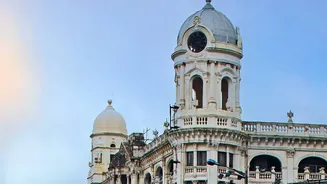
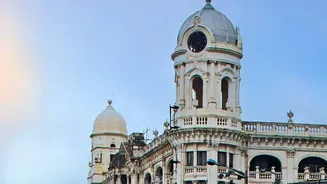
side is the formidable Writers’ Building. Originally built in 1777 to house the junior clerks or ‘writers’ of the East India Company, this red-brick, Greco-Roman structure was the city’s first three-storey building. Its striking facade, adorned with Corinthian columns and statues, became the seat of the Bengal government and a symbol of colonial power. The square itself, centered around the historic Lal Dighi water tank, is surrounded by other colonial giants like the impressive General Post Office (GPO) with its grand dome, and the former Treasury Building, creating one of the world's most intact colonial city centers.
The Grandeur of the Raj Bhavan
Just south of B.B.D. Bagh lies the Raj Bhavan, the former residence of the Viceroy of India. This grand Neoclassical building was designed to project the power and permanence of the British Empire. Completed in 1803, its design is said to be inspired by Kedleston Hall in Derbyshire, England. For over a century, this was the epicentre of political power for the entire subcontinent, hosting lavish balls and making decisions that shaped history. While it now serves as the official residence of the Governor of West Bengal and access is restricted, its imposing gates and sprawling grounds offer a glimpse into the sheer scale of imperial ambition. Its proximity to the administrative offices in Dalhousie Square was a deliberate move to create a compact and unassailable zone of British authority.
A Monument to an Empress: Victoria Memorial
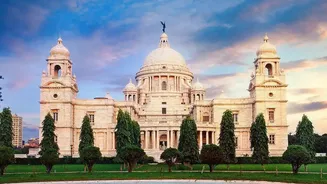
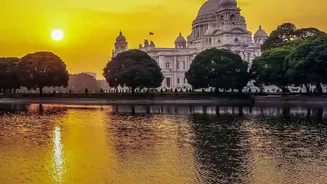
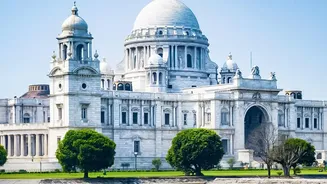
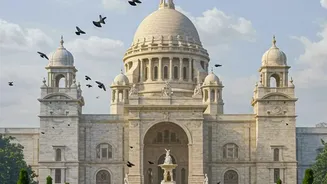
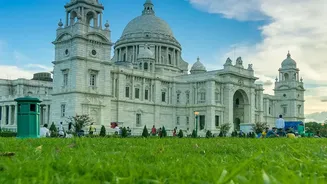
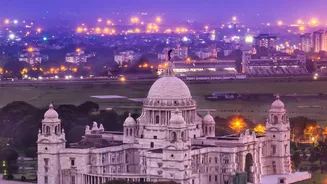
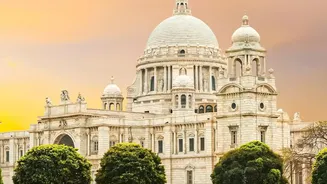
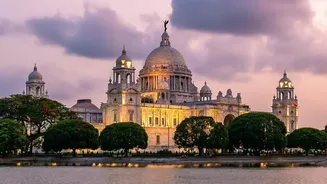
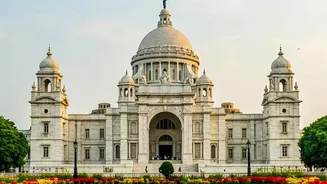
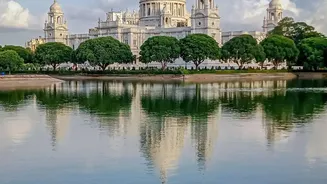
Perhaps no structure is more synonymous with Kolkata than the Victoria Memorial. Conceived by Lord Curzon after the death of Queen Victoria in 1901, this magnificent monument was completed in 1921. Crafted from the same white Makrana marble as the Taj Mahal, it is a stunning example of the Indo-Saracenic revivalist style, blending British and Mughal architectural elements with Venetian and Egyptian influences. Its massive dome, topped by the bronze 'Angel of Victory', is a defining feature of the city's skyline. More than just a memorial, it was intended as a museum to celebrate the British Empire's story in India. Today, its galleries house a vast collection of paintings, sculptures, and artefacts from the colonial period, making it an essential stop for understanding the era's art and history.
Faith and Gothic Spires: St. Paul's Cathedral
A short walk from the Victoria Memorial stands St. Paul's Cathedral, a serene counterpoint to the city's hustle. Completed in 1847, it was the first Anglican cathedral built in Asia and a pioneering example of Gothic Revival architecture in a tropical climate. The style was termed 'Indo-Gothic', adapted to suit Indian conditions with a large nave and an iron-truss roof to span the wide space without obstructive pillars. The original spire was destroyed in earthquakes and later redesigned, modeled on the Bell Harry Tower of England's Canterbury Cathedral. Inside, the atmosphere is one of quiet grandeur, with beautiful stained-glass windows, including one designed by the pre-Raphaelite artist Sir Edward Burne-Jones, and numerous plaques and memorials that tell the stories of the British community in India.
Beyond the Official Quarter
The architectural legacy of the British is not confined to grand public buildings. A journey into North Kolkata reveals a different side of the city's past, where the Bengali elite built palatial mansions, or 'rajbaris'. Structures like the Marble Palace, built in 1835 by Raja Rajendra Mullick, showcase a fascinating fusion of Neoclassical, Bengali, and even Chinese architectural styles, reflecting the cosmopolitan tastes and immense wealth of local merchants. Further afield, the South Park Street Cemetery, established in 1767, offers a hauntingly beautiful look at the past, with its collection of elaborate Gothic and Indo-Saracenic tombs and mausoleums. These sites, along with countless other heritage buildings scattered across the city, provide a richer, more nuanced picture of Kolkata's complex colonial history.