



What is the ‘Blaze Star’?
Deep in the cosmos, about 3,000 light-years from Earth, lies a fascinating star system called T Coronae Borealis. It's not a single star but a binary pair, locked in a dramatic cosmic dance. For this reason, it’s not always visible to the naked eye. Most
of the time, it’s a faint object that requires a telescope to spot. But roughly every 80 years, it bursts into brilliant life, earning it the nickname ‘the Blaze Star.’ This recurring outburst, known as a nova, is what has astronomers and amateur sky-watchers buzzing with anticipation. The system consists of a white dwarf—the dense, hot corpse of a sun-like star—and an aging red giant, a star that has swollen to enormous size.
The Cosmic Dance of Two Stars
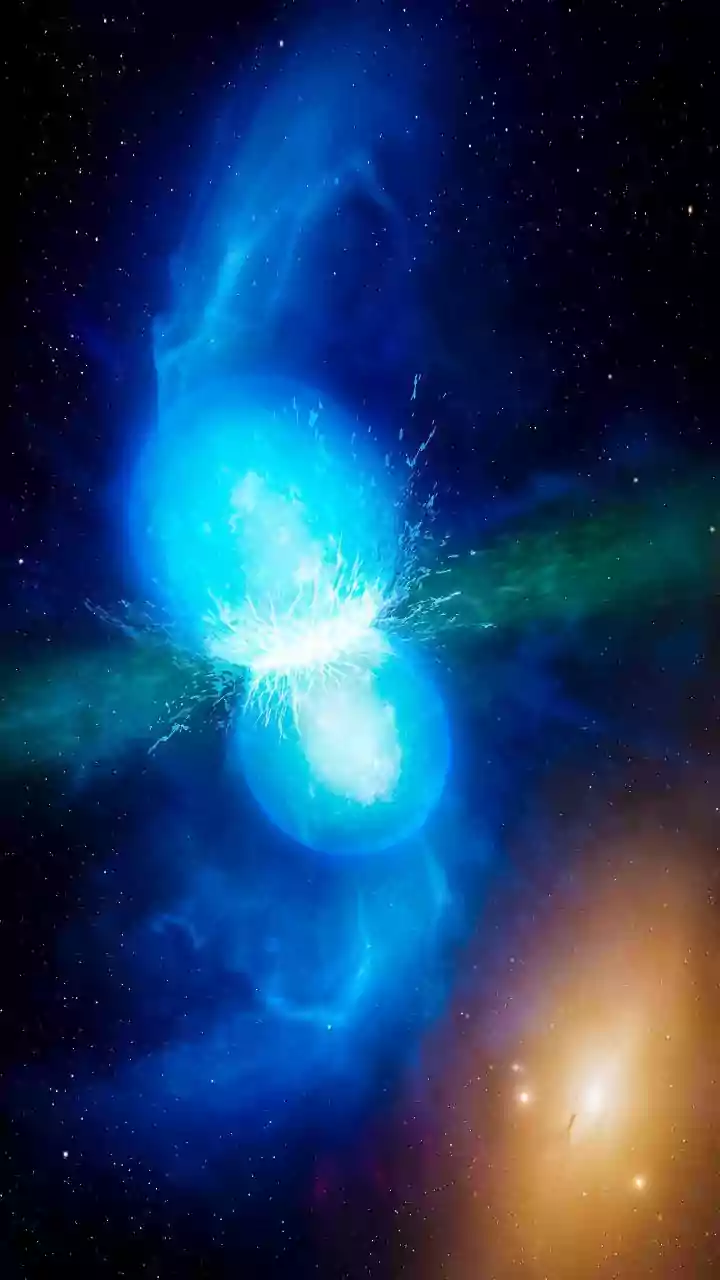
The relationship between these two stars is what fuels the impending explosion. The red giant is a messy partner. Its immense size means its gravitational hold on its outer layers is weak. As it orbits the compact white dwarf, the smaller star’s intense gravity relentlessly pulls hydrogen gas from the red giant’s atmosphere. This material doesn't fall directly onto the white dwarf but instead gathers around it, forming a swirling, superheated disc of matter called an accretion disc. Over decades, this hydrogen piles up on the surface of the white dwarf, like cosmic dust settling on a celestial table. But this is no ordinary dust—it's fuel for a massive explosion.
An Explosive Thermonuclear Event
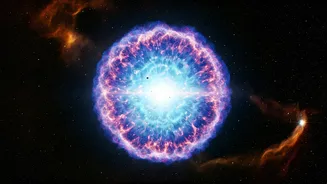
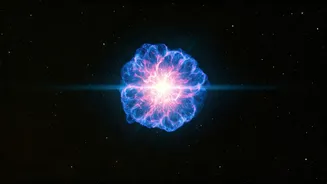
As the layer of stolen hydrogen grows thicker, the pressure and temperature at its base build to an incredible degree. Eventually, it reaches a critical point—around 10 million degrees Celsius—triggering a runaway thermonuclear fusion reaction. This is the nova. The entire surface layer of hydrogen ignites in a cataclysmic blast, flinging scorching material out into space and causing the system to brighten by a factor of thousands. It's important to distinguish this from a supernova. In a supernova, the star itself is destroyed. A nova, however, is a surface-level event. The white dwarf remains intact, ready to begin the cycle of accretion all over again. This is why T Coronae Borealis is a ‘recurrent nova’—it’s been seen before and will be seen again.
When and How to See It
This is the most exciting part: the next eruption is imminent. Astronomers predict it will happen sometime between now and September 2024. While the exact date is impossible to pinpoint, the lead-up to the event is being closely monitored. Normally, T Coronae Borealis has a magnitude of +10, far too dim to see without a telescope. But during the nova, it’s expected to flare up to a magnitude of +2. This is as bright as Polaris, the North Star, and will make it easily visible to the naked eye, even in light-polluted urban skies.
To find it, you’ll need to locate the constellation Corona Borealis, or the ‘Northern Crown’—a small, C-shaped arc of stars situated between the bright stars Vega and Arcturus. The nova will appear as a ‘new’ star in this crown. It will only be visible for a few days at peak brightness before it begins to fade, so you'll have to be quick.
A Once-in-a-Generation Spectacle
The 80-year cycle of T Coronae Borealis makes this a truly special event. The last two confirmed eruptions were in 1866 and 1946. For most people alive today, this will be their only chance to witness this particular celestial firework. Seeing a star system undergo such a violent and beautiful transformation with your own eyes is a powerful reminder of the dynamic and ever-changing nature of the universe. It connects us to a cosmic clock that ticks on a scale far grander than our own lives, with past generations having looked up at this very same ‘new’ star. This isn't just an astronomical curiosity; it's a shared human experience written in the stars.