



A Sugar Found Among the Stars
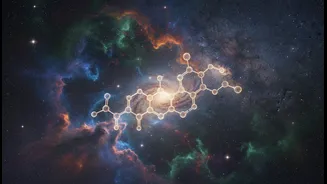
In a landmark discovery, an international team of astronomers has detected a sugar molecule called erythrulose floating in a vast cloud of gas and dust some 27,000 light-years from Earth. The finding was made by pointing powerful radio telescopes in Spain
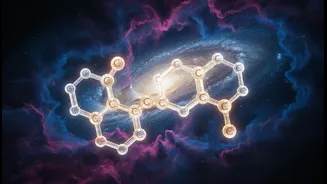
toward a molecular cloud known as G+0.693-0.027, a chemically rich stellar nursery near the galactic centre. While simpler organic molecules have been found in space before, this marks the first time a true sugar has been identified in the interstellar medium. Erythrulose is a four-carbon sugar, and while it might not be a household name like glucose, it’s found on Earth in raspberries. Its presence so far from any planet suggests that the building blocks for life may be more common in the cosmos than previously imagined.
The Old Recipe for Life
For decades, the leading theory for the origin of life has been the "RNA World" hypothesis. This idea proposes that before DNA and proteins, life was based on RNA (ribonucleic acid). RNA is simpler than DNA and can perform double duty, both storing genetic information and acting as an enzyme to catalyse chemical reactions. However, the RNA World has a crucial ingredient problem. The backbone of RNA is made from a five-carbon sugar called ribose. Scientists have struggled to explain how large quantities of stable ribose could have formed on early Earth, as lab experiments show it is difficult to create under prebiotic conditions and is inherently unstable. This has been a major hurdle in our understanding of abiogenesis, the process by which life arises from non-living matter.
A Simpler, Sturdier Alternative
The discovery of erythrulose in space provides a compelling new clue. Erythrulose is a tetrose, meaning it has a four-carbon backbone. Scientists have theorised about a potential precursor to RNA made from a similar four-carbon sugar called threose. This hypothetical genetic system is known as Threose Nucleic Acid, or TNA. In theory, TNA is simpler to form than RNA and more stable. It can also transfer genetic information to and from RNA, providing a plausible bridge from a pre-RNA world to the RNA world. The problem was a lack of evidence that four-carbon sugars could form in significant quantities in a prebiotic environment. Finding erythrulose in an interstellar cloud provides that evidence. It shows that the universe is capable of making these sugars in the vast, cold factories of molecular clouds.
Cosmic Delivery Service
The existence of erythrulose in a star-forming region like G+0.693-0.027 has a clear implication: these molecules could have been delivered to a young Earth. Molecular clouds are the birthplaces of stars and planetary systems. As our own solar system formed, the materials from its parent cloud, including water, dust, and complex organic molecules, would have been incorporated into comets and asteroids. Scientists estimate that millions of tonnes of erythrulose could have been delivered to Earth during the Late Heavy Bombardment, a period of intense comet and asteroid impacts about 4 billion years ago. This cosmic delivery could have seeded the early planet with the necessary ingredients, bypassing the difficulty of creating these complex sugars on Earth's surface and providing the raw materials for a TNA-based precursor to life.
A New Path for Life's Origins
Perhaps the most surprising part of the discovery was the abundance of erythrulose compared to simpler, three-carbon sugars, which were not detected at all. This contradicts the long-held chemical assumption that complexity builds one carbon atom at a time. Instead, it seems erythrulose may form from the combination of two-carbon molecules on the surface of icy dust grains. This opens up entirely new possibilities for prebiotic chemistry. The pathway to life might not be a single, linear road, but a network of branching paths. “The detection of erythrulose is very exciting because it opens up the possibility of discovering in space other sugars such as ribose, which is part of RNA, and other important molecules for the origin of life,” said Carlos Briones, a co-author of the study. The search is now on for even more complex prebiotic molecules in the cradles of stars, reshaping our quest to understand where we came from.