



A Time Machine to the Cosmic Dawn
The JWST is essentially a powerful time machine. Because light takes billions of years to travel across the universe, when we look at the most distant galaxies, we are seeing them as they were shortly after the Big Bang. The telescope's unparalleled sensitivity
to infrared light allows it to capture the faint glow from the universe's first stars and galaxies, objects that have been beyond our reach until now. Recent observations have identified galaxies from when the universe was just a few hundred million years old, providing a direct window into the cosmic dawn. This allows astronomers to test theories about how the first galaxies formed and organized themselves into the massive structures we see today.
Peering Through Dust to See Stars Being Born
Many of the most dramatic events in the universe, like the birth of stars and planets, happen inside dense clouds of gas and dust. Visible light telescopes, like Hubble, can't see through these cosmic nurseries. The JWST, however, is designed to see in infrared, which can penetrate these dusty veils. This has given astronomers an unprecedented look at protostars and the swirling disks of material around them where planets form. By studying these hidden environments, scientists are gathering crucial clues about how stellar systems like our own solar system came to be and what determines the variety of stars and planets throughout the universe.
Analysing the Air of Other Worlds
One of the most exciting capabilities of the JWST is not just taking pictures, but analysing light with a technique called spectroscopy. When a planet passes in front of its star, the telescope can 'read' the chemical fingerprints in the starlight that filters through the planet's atmosphere. This allows scientists to detect the presence of elements like water, methane, and carbon monoxide. A recent discovery used this very technique to find a previously hidden giant planet, Beta Pictoris d, by identifying its atmospheric signature. This new method could be a game-changer for finding planets, especially those obscured by cosmic dust. It's a major step toward understanding the climates of distant worlds and assessing their potential for hosting life.
Untangling Galactic Histories
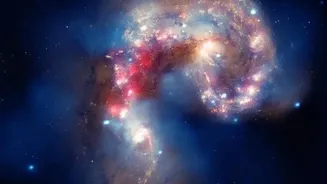
Galaxies are not static; they collide, merge, and evolve over billions of years. To celebrate its fourth year of science operations in July 2026, the JWST released a stunningly detailed image of Centaurus A, a nearby galaxy known for its unusual shape. The galaxy is the result of a merger with another galaxy about two billion years ago. While previous telescopes could see the large-scale structures, JWST's clarity cuts through the obscuring dust to reveal millions of individual stars and the complex inner workings of the galaxy's active supermassive black hole. These observations help scientists understand how galactic collisions trigger intense bursts of star formation and how central black holes influence the growth and, sometimes, the death of their host galaxies.