



The Quest for Lunar Water
Finding water on the Moon isn't just about quenching the thirst of future astronauts. Water (H2O) can be split into hydrogen and oxygen, providing breathable air and, crucially, rocket propellant. This could turn the Moon into a refuelling station for
missions to Mars and beyond, dramatically reducing the cost of deep space exploration. The lunar south pole is of particular interest because its permanently shadowed craters are so cold that they could have trapped water ice for billions of years. Confirming its presence and accessibility is a primary goal for space agencies worldwide.
ISRO’s Subsurface Detective: ChaSTE
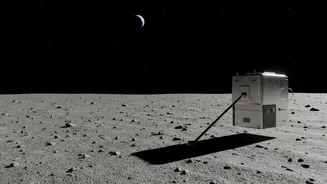
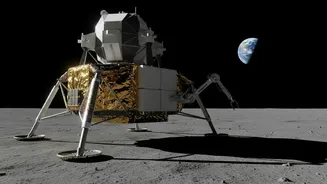
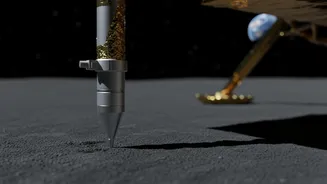
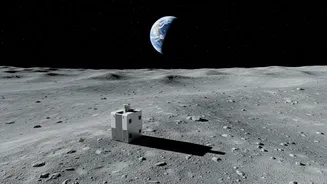
The star instrument for this task aboard ISRO's Vikram lander is the Chandra’s Surface Thermophysical Experiment, or ChaSTE. Developed by the Physical Research Laboratory (PRL) and Space Physics Laboratory (SPL), it is the first instrument to successfully penetrate the lunar soil and measure temperature variations below the surface near the south pole. It consists of a probe with 10 individual temperature sensors that is gently pushed into the lunar topsoil, known as regolith, to a depth of 10 centimetres. This allows scientists to create a temperature profile, essentially a thermal map of the shallow subsurface.
Reading the Thermal Clues
So, how does temperature reveal water? The key lies in thermal conductivity—how easily heat travels through a substance. Lunar regolith is generally a very poor conductor of heat, which is why there's a huge temperature swing between the sunlit surface and just a few centimetres below. However, the presence of ice mixed into the soil would change its thermal properties. Ice is a better conductor of heat than loose, dry dust. By measuring the temperature at different depths and how it changes over the course of a lunar day, scientists can model the thermal behaviour of the ground. If the data shows heat moving in a way that is inconsistent with dry regolith, it provides strong indirect evidence that a substance like water ice is present, influencing the heat flow. The ChaSTE data helps scientists understand the stability of water ice in the subsurface.
Complementing with Surface Chemistry
While ChaSTE probes the thermal properties underground, instruments on the Pragyan rover, which was deployed by the lander, analyze the chemical makeup of the surface. The Laser-Induced Breakdown Spectroscope (LIBS) and the Alpha Particle X-ray Spectrometer (APXS) work together to identify the elements present in the lunar soil and rocks. LIBS fires a high-energy laser at the surface, creating a tiny puff of plasma. By analysing the light from this plasma, scientists can identify the elements present, such as aluminium, silicon, iron, and sulphur. The APXS bombards the surface with alpha particles and X-rays to determine the elemental composition in a different way. While these instruments are primarily hunting for various minerals, their data is crucial in the search for water's components, especially hydrogen, though its direct detection remains an ongoing investigation.
Building a Complete Picture
Neither thermal data nor elemental composition alone can definitively confirm vast, accessible reserves of water ice. The real strength of ISRO's approach is combining these different datasets. Scientists take the thermal profile from ChaSTE, which hints at the physical state of the subsurface, and cross-reference it with the elemental composition from LIBS and APXS. For example, if ChaSTE indicates unusual thermal conductivity in a specific area, and rover instruments detect higher-than-expected concentrations of hydrogen (a key component of water) in the same vicinity, the case for water ice becomes much stronger. This multi-pronged approach, combining physics and chemistry, allows scientists to build a more robust and detailed model of the lunar environment, significantly advancing the evaluation of the Moon's water potential.