





Trail Hiking: The Cardio Climber
Hiking is one of the most accessible and effective cardiovascular exercises available. Its power lies in its variability. A simple walk on a flat trail provides a gentle aerobic workout, but add hills and uneven terrain, and it transforms into a natural
form of high-intensity interval training. Every incline forces your heart to pump harder, strengthening the cardiac muscle and improving its efficiency. Over time, this can lead to a lower resting heart rate, reduced blood pressure, and better overall cardiovascular health. The physical demands are primarily focused on the lower body. Your quadriceps, hamstrings, glutes, and calves do the heavy lifting, especially on steep sections. However, navigating uneven ground also engages your core muscles for stability. Beyond the physical, hiking offers significant mental health benefits, with studies suggesting that time spent in nature can reduce stress and improve mood. In India, with access to everything from the Western Ghats to the Himalayan foothills, there's a trail for every fitness level.
Paddleboarding: A Workout on Water
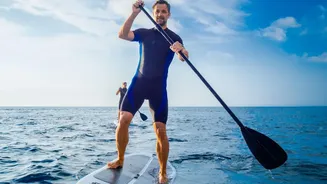
Stand-up paddleboarding might look serene, but it’s a surprisingly comprehensive workout. Its uniqueness comes from combining a steady cardiovascular challenge with a constant need for balance. To stay upright on the board, your body must make thousands of tiny adjustments, which fires up the deep stabilizing muscles in your core, including your abs, obliques, and lower back. This makes SUP one of the most effective core workouts you can do. Every paddle stroke is a full-body movement, engaging your lats, shoulders, and arms, while your legs and glutes remain tensed to maintain your stance. This holistic muscle engagement means you're building functional strength that translates to better posture and everyday movements. As a low-impact activity, paddleboarding is also gentle on the joints, making it an excellent choice for people of all ages or those recovering from certain injuries.
Cardio: Intensity vs. Sustained Effort
When it comes to cardiovascular benefits, the two activities offer different approaches. Trail hiking provides a direct and often intense heart rate challenge. Climbing a steep hill will quickly push you into higher heart rate zones, boosting your aerobic capacity. The intensity is customizable; you can choose tougher trails or carry a pack to increase the demand. Paddleboarding, by contrast, typically provides a more moderate and sustained cardio session. A casual paddle keeps your heart rate in a steady aerobic zone, excellent for building endurance. However, you can easily ramp up the intensity by paddling faster, performing sprint intervals, or heading into choppier water, which requires more effort to both balance and propel yourself. A vigorous paddle can burn a significant number of calories, comparable to hiking.
Strength and Balance: Full Body vs. Lower Body
This is where the two activities truly diverge. Hiking is a lower-body powerhouse. It builds incredible strength and endurance in your legs and glutes. While your core is engaged for stability, the primary workload falls on the muscles below your waist. Paddleboarding delivers a more balanced, full-body workout. The constant need to stabilize on a moving surface means your core never gets a break. Furthermore, the act of paddling is a pulling motion that heavily involves the large muscles of your back and shoulders, groups often neglected in lower-body exercises like hiking or running. While hiking requires good balance on uneven terrain, balance is the very foundation of paddleboarding. It constantly challenges your proprioception—your body's sense of its position in space—leading to significant improvements in stability over time.
Which One Is Right for You?
Choosing between hiking and paddleboarding depends entirely on your fitness goals and what you enjoy. If your main goal is powerful cardiovascular conditioning and building serious leg strength, hiking is an unparalleled choice. It's also highly accessible, requiring little more than a good pair of shoes and a nearby trail. If you're looking for a low-impact, full_body workout with a heavy emphasis on core strength and balance, paddleboarding is the clear winner. It’s a fantastic way to build functional strength that supports all other activities. It does require access to a calm body of water and more specialized equipment, but the unique combination of physical and mental benefits makes it a rewarding pursuit.