


The Promise of Polar Ice
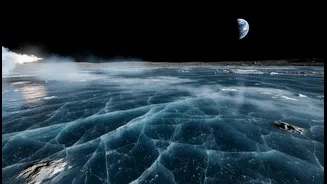
For decades, the Moon was considered a dry, barren world. But a series of missions confirmed the presence of water ice, especially in permanently shadowed craters near the lunar poles. This discovery was a game-changer. This ice, potentially billions
of years old, isn't just a scientific treasure chest that could hold clues to the origin of water in our solar system; it's also a vital resource for future exploration. For a long-term human presence, this ice could be mined and processed into drinkable water, breathable oxygen, and, most importantly, hydrogen and oxygen for rocket fuel. Manufacturing propellant on the Moon would dramatically reduce the cost and complexity of missions to Mars and beyond, making our satellite a crucial stepping stone into the cosmos.
An Unintended Consequence of Arrival
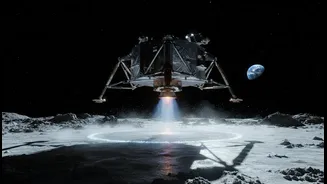
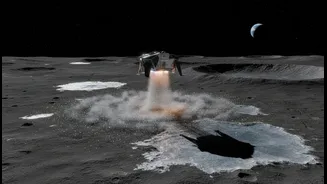
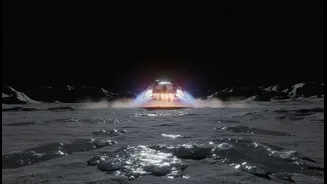
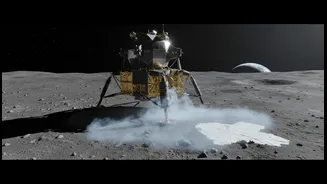
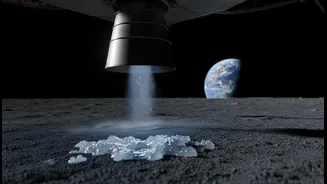
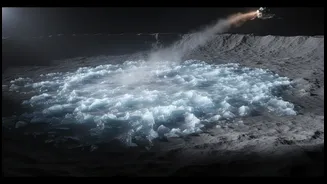
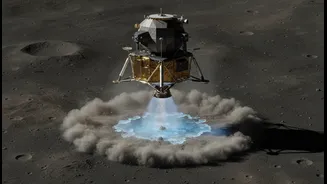
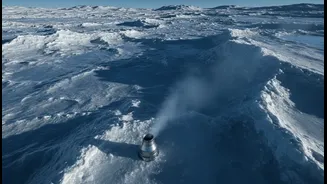
The problem is that getting to the Moon involves powerful rocket engines that burn propellant, producing their own water vapor and other chemicals, like methane, as exhaust. In the Moon's near-vacuum, this exhaust doesn't just dissipate. Computer simulations show that the plume from a single landing can spread globally in mere hours. The molecules hop across the surface in ballistic trajectories, eventually settling in the coldest places available: the same permanently shadowed craters that hold the pristine, ancient ice scientists are so eager to study. This means that a lander touching down hundreds of kilometers away can still contaminate these vital polar regions. In effect, our arrival risks spoiling the very prize we came to collect.
The Science of Contamination
The contamination is a two-fold problem. First, it complicates the science. The native lunar ice is a physical record of the solar system's history, delivered by comets and asteroids over eons. By measuring its composition and isotopes, scientists hope to learn about the formation of Earth and the origins of life. Introducing modern, artificial water and methane from rocket exhaust hopelessly muddies this ancient record. Second, it affects resource utilization. The larger the landers, the more water they deposit. A SpaceX Starship, for example, could deposit over 10 tons of water, potentially mixing with and overlaying the natural ice. This makes it difficult to assess the quality and quantity of the native resource before setting up expensive mining operations.
Rewriting the Rules for Landing
This challenge has triggered a new focus on planetary protection for the Moon, an area previously considered low-risk. The Committee on Space Research (COSPAR), which sets international guidelines, has updated its policy to create special designations for missions targeting the polar regions. These areas now require missions to document their organic inventory, a step not required for most other lunar landings. This is part of a broader conversation encapsulated in frameworks like the Artemis Accords, which call for the deconfliction of space activities and the avoidance of harmful interference. Scientists are advocating for a new mindset, comparing the Moon's unique environments to protected areas like Antarctica on Earth, arguing they are just as valuable and fragile.
A New Era of Lunar Exploration
The solution isn't to stop exploring, but to explore smarter. This shift is driving innovation in landing technology and mission planning. NASA and its partners are heavily invested in developing precision landing and hazard avoidance systems. Being able to land with an accuracy of tens of meters, rather than kilometers, allows missions to target safe, stable ground while maintaining a respectful distance from scientifically sensitive zones. Other strategies being explored include choosing colder landing sites to better contain exhaust molecules and investigating whether the contamination is only surface-deep, leaving purer ice below. Ultimately, future missions will need to routinely model, monitor, and mitigate the impact of their own exhaust as a standard part of operations, heralding a new era of environmental responsibility in space.