





Argentina's Defensive Fortress
Under Lionel Scaloni, Argentina have built their success on a foundation of defensive solidity and tactical flexibility. Throughout the 2026 tournament, they have defended as a compact, organised unit, often in a 4-4-2 or 4-2-3-1 shape out of possession.
Rather than pressing high relentlessly, they prioritise keeping the spaces between the lines incredibly tight, forcing opponents wide. This forces teams into predictable areas where Argentina can then overload and win back the ball. With aggressive, front-foot centre-backs like Lisandro Martínez and Cristian Romero, they are experts at snuffing out danger before it develops. Their system is designed to control the middle of the pitch, protect the backline, and provide a platform for their world-class attackers. However, this aggressive approach is not without its risks.
The Chink in the Armour
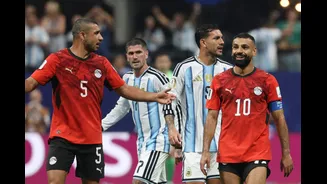
Argentina's primary defensive vulnerability has been exposed during the 2026 knockout rounds: space in behind. Teams that have troubled them, like Egypt and even Switzerland, did so with direct pace and quick transitions. Because their defenders, particularly Romero and Martínez, are so aggressive in stepping forward to engage attackers, they can leave gaps for runners to exploit. This was seen when Egypt's quick forwards caused them problems on the counter-attack. Furthermore, the team defends with essentially nine outfield players, as Lionel Messi, now 39, is tasked with conserving energy for attacking moments. This tactical compromise means that if opponents can bypass the initial midfield press, there are opportunities to create overloads and attack the backline directly, a weakness former England captain Wayne Rooney has pointed out.
Kane The Playmaker, Not Just The Poacher
This is where Harry Kane’s evolution into one of the world's most complete forwards becomes England’s master key. While his goalscoring remains elite—with six goals at this tournament putting him in contention for the Golden Boot—it’s his work outside the box that poses the biggest threat to Argentina. Over the past few years, Kane has transformed into a hybrid No. 9 and No. 10. He is no longer a static target man; he is a deep-lying playmaker who orchestrates attacks. His tendency to drop into midfield is not a sign of retreat but a calculated tactical weapon. By moving away from the forward line, he poses a dilemma for Argentina's aggressive centre-backs: follow him and leave a massive gap in the heart of the defence, or let him go and allow him the time and space to pick a defence-splitting pass.
Creating Space for England's Runners
Kane dropping deep is the trigger for England's real attack. His movement is designed to pull a player like Cristian Romero out of his comfort zone and into midfield. The moment that happens, the space Romero vacates becomes the target for England's pacy wide players and attacking midfielders. Players like Jude Bellingham, who has also scored six goals this tournament, and Bukayo Saka are experts at making perfectly timed runs from deep. Kane possesses the vision and passing range to find them. This tactical pattern—Kane dropping, a defender following, and a runner exploiting the space—is precisely the kind of fast, direct attack that has troubled Argentina. It turns Argentina's defensive aggression into a liability, using their own system against them.
The Traditional No. 9 Threat Remains
Even if Argentina’s defenders show the discipline to hold their position and not follow Kane, he still presents a significant problem. If he is given space between the lines, he can turn and shoot from distance or orchestrate play with impunity. And in the final third, he remains a lethal finisher and a dominant physical presence. England also holds a distinct advantage in set-piece situations, where Kane's aerial ability comes to the fore. He is a complete forward at the peak of his powers, having covered more ground than any other England player at this World Cup. This unique combination of playmaking intelligence and traditional striker's instincts makes him the ultimate puzzle for Scaloni's side. He can be the player who draws the foul, the one who delivers the final pass, or the one who puts the ball in the back of the net.