




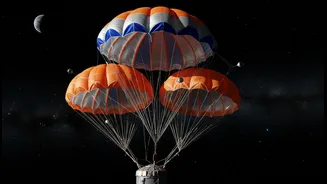


The Fiery Return to Earth
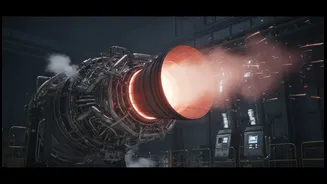
When the Gaganyaan crew module begins its journey back home, it will be screaming through the atmosphere at hypersonic speeds, many times faster than the speed of sound. This re-entry process generates immense heat and dynamic pressure, making it one
of the most dangerous phases of any human spaceflight mission. The primary challenge is to slow the capsule from over 28,000 kilometres per hour in orbit to a gentle splashdown speed in the ocean. This requires a meticulously choreographed sequence of braking manoeuvres, where a single misstep is not an option. The system must be robust, reliable, and, for a sustainable space program, as cost-effective as possible.
A Symphony of Ten Parachutes
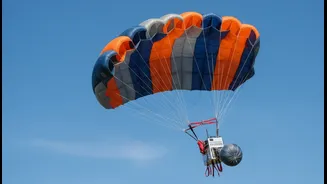
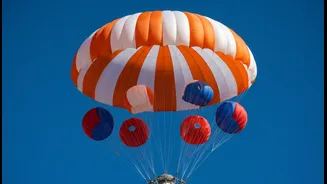
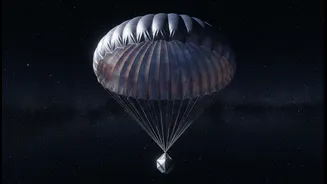
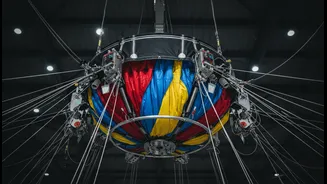
At the heart of Gaganyaan's recovery is a complex, ten-parachute deceleration system, a joint effort by ISRO and DRDO. This is not a simple case of pulling a ripcord. The process begins after the module has re-entered the atmosphere, with the deployment of two Apex Cover Separation parachutes that jettison the protective cover of the main parachute compartment. Following this, two crucial Drogue Parachutes are deployed. These smaller, highly durable chutes are designed to withstand the enormous forces of high-speed descent. Their main job is to stabilise the tumbling capsule and reduce its velocity from supersonic to subsonic speeds, preparing it for the next critical stage.
From High Speed to a Gentle Splash
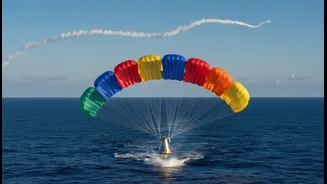
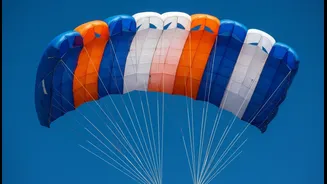
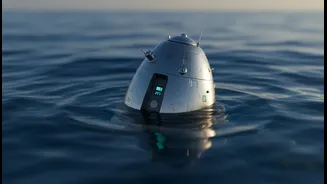
Once the drogue parachutes have done their job and are jettisoned, the main event begins. Three small Pilot Parachutes are released, each tasked with pulling out one of three large Main Parachutes. These main chutes are the workhorses of the braking system, responsible for the final and most significant phase of deceleration. To prevent the massive canopies from being torn apart by the initial shock, they employ a technique called 'reefing', where they are opened in controlled stages. This sophisticated process ensures a gradual slowdown, bringing the capsule's speed down to less than 9 metres per second for a safe and gentle splashdown in the Indian sea. The system is built with redundancy; a safe landing is possible even if one of the three main parachutes fails to deploy.
The 'Cost-Effective' Breakthrough
The term 'revolutionises' in the headline points to the system's impact on mission economics. The cost-effectiveness stems from two key areas: precision and reusability. The high reliability and precise control offered by the multi-stage parachute system allow ISRO and the Indian Navy to predict the splashdown location with greater accuracy. This significantly narrows the search area in the ocean, reducing the time and resources needed for recovery operations, which involve ships, aircraft, and specialised teams. A quicker, more efficient recovery lowers operational costs. Furthermore, the gentle landing minimises structural stress on the crew module itself. This is crucial for the long-term goal of refurbishing and reusing the capsules for future missions, a cornerstone of making human spaceflight economically sustainable for India. Testing this system cost-effectively has also been a priority, with ISRO developing the Sub-Orbital Launch Vehicle for Experiments (SOLVE) to simulate re-entry conditions without the expense of a full orbital launch.
Enabling India's Future in Space
Mastering this braking and recovery technology is non-negotiable for the Gaganyaan program, which aims to send a three-member crew to an orbit of 400 km and return them safely. ISRO has been rigorously testing every component, from airdrop tests using IAF aircraft to simulations of various failure scenarios, to ensure the system is flawless. Recent successful tests, like the Integrated Main Parachute Airdrop Test (IMAT), have validated the design and boosted confidence ahead of the first uncrewed test flights. This multi-stage braking mechanism is more than just a set of parachutes; it is a critical enabling technology that underpins the safety of India's astronauts and the financial viability of its future human spaceflight ambitions, paving the way for potential space stations and deeper space exploration.