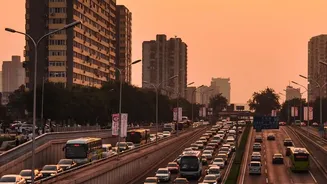







The quintessential urban dream in India often clashes with a stark reality: you can have a large, spacious home, or you can have a short, easy commute. Rarely do you get both. It’s the ultimate trade-off for homebuyers and renters alike.
The Allure of More Space
The desire for
a bigger home is stronger than ever. The pandemic normalised remote work, turning homes into offices, classrooms, and gyms overnight. This shift has made a spare room for a dedicated workspace feel less like a luxury and more like a necessity. As a result, average flat sizes in India's top cities have seen an increase. Buyers are gravitating towards the peripheries—think Navi Mumbai instead of South Mumbai, or the outer belts of Bengaluru—where they can afford larger configurations like 3BHKs, often within integrated townships. These areas promise a quieter lifestyle, less pollution, and amenities like parks and community facilities that are a major draw for families. The trade-off, however, is that this housing often arrives before the supporting infrastructure, meaning residents might initially face a lack of schools, shops, and reliable public transport.
The High Price of Proximity
On the other side of the coin is the undeniable advantage of connectivity. Living in the urban core means shorter commutes, which studies consistently link to better mental health, lower stress, and improved work-life balance. A shorter commute frees up valuable time for family, hobbies, and rest. Well-connected areas in cities like Mumbai, Delhi, and Bengaluru offer unparalleled access to jobs, premier schools, hospitals, and cultural hubs. This convenience comes at a steep cost. Property prices per square foot in central urban areas can be two to three times higher than in the suburbs. Consequently, apartments are significantly smaller. For instance, Mumbai has the smallest average home sizes among India's top cities, a direct result of extreme land scarcity and high property values.
A Financial Deep Dive
The choice isn't just about square feet versus travel time; it's a complex financial equation. A larger home in a suburban area might have a comparable or even lower EMI than a compact city-centre flat. However, the sticker price doesn't tell the whole story. The 'hidden costs' of a long commute can be staggering. These include not just fuel and vehicle maintenance but also the economic cost of lost productivity. One study estimated that traffic congestion in India's four major metros costs the economy over ₹1.5 lakh crore annually. For an individual, this translates into thousands of rupees and countless hours lost each year. In contrast, a smaller apartment in a prime location often comes with lower utility bills and maintenance costs. It may also prove to be a better longterm investment, as properties in wellconnected areas with strong infrastructure tend to appreciate faster.
Lifestyle, Community, and Wellbeing
Beyond the numbers, the decision profoundly impacts your lifestyle. A smaller, centrallylocated home encourages a different way of living. It might push you to adopt a more minimalist mindset and spend more time outside your home, utilising public parks, cafes, and cultural spaces. This can lead to a stronger sense of community as you interact more with your local neighbourhood. Conversely, a large suburban house provides private space for family activities, gardening, and relaxation, which many find essential for their wellbeing. However, long commutes associated with suburban living have been linked to health issues like anxiety, depression, and social isolation, chipping away at the very quality of life that a larger home is meant to provide.
Making the Right Choice for You
Ultimately , there is no one size fits all answer . The 'right' choice depends entirely on your personal priorities , life stage , and professional circumstances . If you work from home or have a flexible schedule , the appeal of a larger , more affordable suburban home is hard to ignore . The rise of hybrid work models has already prompted many to make this move . If your job requires you to be in the office daily and you value a vibrant social life with easy access to amenities , the premium for a wellconnected , albeit smaller , urban apartment may be well worth it . Before you decide , map out the true costs—both financial and personal . Calculate potential commute times and expenses , consider your family 's needs , and think about what truly defines 'quality of life' for you .