


Meet a Cosmic Neighbour
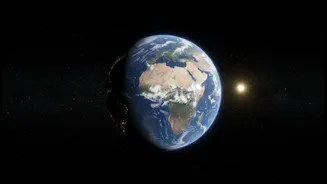
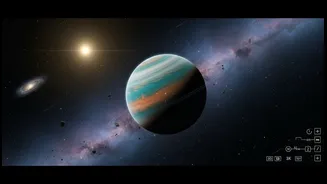
The planet in question has a name: Gliese 12 b. While the headline figure is 25 light-years, this specific world is a bit further, at a distance of about 40 light-years in the constellation Pisces. In cosmic terms, that's just next door. Discovered using
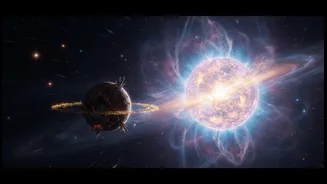
data from NASA's TESS satellite, it is slightly smaller than Earth and comparable in size to Venus. It orbits its star, a cool red dwarf, every 12.8 days. This tight orbit places it in an interesting position. It receives more energy than Earth but less than Venus, making it a fascinating middle ground. The key factor is its star; because red dwarfs are smaller and cooler than our sun, a planet can orbit much closer and still have temperatures that might allow for liquid water.
The Crucial Question of an Atmosphere
A planet's location is only half the story. The single most important question scientists are trying to answer about Gliese 12 b is whether it has an atmosphere. An atmosphere is crucial for a planet to be considered habitable. It traps heat, protects the surface from harsh stellar radiation, and allows for stable liquid water on the surface. Without it, a world is just a barren rock. Scientists estimate that if Gliese 12 b has no atmosphere, its surface temperature would be around 42°C (107°F). But the presence of an atmosphere could change that number dramatically. It could have a temperate, Earth-like atmosphere, a crushing, runaway greenhouse-effect atmosphere like Venus, or no atmosphere at all.
How to See an Invisible Atmosphere
How do you study something so small and so far away? Scientists use a technique called transmission spectroscopy. When Gliese 12 b passes in front of its star from our perspective—an event called a transit—the starlight filters through the planet's atmosphere, if one exists. Powerful instruments, like those on the James Webb Space Telescope (JWST), are designed to analyse this filtered light. Different gases in an atmosphere absorb specific wavelengths of light. By looking at which colours are missing from the starlight after it passes through the atmosphere, scientists can read its chemical 'fingerprint' and determine what it's made of.
A Stepping Stone, Not a New Earth
Gliese 12 b is particularly exciting because it's one of the best targets found so far for this kind of atmospheric study. Its size and temperature make it a prime candidate to help answer a huge question in astronomy: can Earth-sized planets orbiting cool red dwarfs hold onto their atmospheres? Red dwarfs are the most common type of star in our galaxy, so the answer has massive implications for how common habitable worlds might be. This planet serves as a perfect natural laboratory. By studying it, astronomers hope to understand the 'habitability pathways' that lead one planet to become a temperate haven like Earth and another to become a scorching hothouse like Venus, our own 'evil twin' in the solar system.