





The Challenge of Capturing the Cosmos
Astrophotography is one of the most demanding forms of photography. Cameras need to collect as much faint, distant light as possible, which traditionally requires large lenses, bulky camera bodies, and long exposure times. Smartphones, with their tiny
sensors and compact lenses, are at a massive physical disadvantage. Long exposures on a phone would normally result in a blurry image due to handshake and a lot of digital 'noise'. This noise appears as a grainy, speckled pattern that ruins image quality, a result of the sensor's uncertainty when detecting very low light levels. For years, this made true night sky photography on a mobile device seem impossible.
Enter Computational Photography
This is where computational photography changes the game. Think of it as using smart software to overcome the physical limitations of the camera hardware. Instead of relying solely on the lens and sensor to do all the work, your phone's processor gets involved to dramatically improve the final image. It's like a master chef creating a gourmet meal from simple ingredients. Your phone doesn't just take one picture; it uses advanced algorithms to process visual data in ways a traditional camera simply cannot. This approach is now fundamental to many smartphone features, including Portrait Mode and HDR, but its most magical application is in conquering the dark.
The Magic of Stacking Images
The core technique behind mobile astrophotography is called image stacking. When you put your phone on a tripod and activate the night or astro mode, it doesn't just take one long picture. Instead, it captures a sequence of multiple, shorter-exposure shots over a period that can last up to four minutes. The phone's software then meticulously aligns these individual frames to compensate for any tiny movements, including the rotation of the Earth. It then digitally averages them together. This process is brilliant because the stars (the 'signal') appear in every frame, so they get brighter and clearer. The random graininess (the 'noise') is different in each frame, so when averaged, it cancels itself out, resulting in a much cleaner, more detailed image.
AI as the Finishing Touch
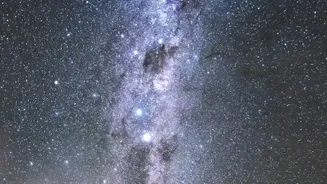
After stacking, Artificial Intelligence (AI) algorithms perform the final cleanup. These sophisticated systems can identify and remove 'hot pixels'—anomalies that can appear during long exposures. More impressively, the AI is trained to recognize the sky itself. It can then selectively enhance contrast and darken the sky to make it look more natural, without affecting the landscape in the foreground. This AI processing helps bring out the faint dust clouds in the Milky Way and ensures star colours appear vibrant, creating a final image that can show more detail than the human eye can see on its own.
The Smartphone Space Race
Google was a pioneer in this field with its Night Sight and dedicated Astrophotography mode on Pixel phones, which automatically activates when the phone is stable. They demonstrated that with the right software, stunning shots of the Milky Way were possible on a mobile. Since then, other major brands have joined the race. Apple has significantly improved the low-light capabilities of the iPhone, using its ProRAW format to give users more editing flexibility. Samsung's flagship Galaxy devices offer an 'Expert RAW' mode with advanced manual controls for those who want to fine-tune their settings. Brands like Xiaomi, OnePlus, and Vivo are also integrating their own powerful sensors and AI algorithms, making high-quality astrophotography accessible to a wider audience across India.
What You Still Need for a Great Shot
While the technology is incredible, it isn't quite magic. To get the best results, you cannot simply hand-hold your phone. These specialised modes require the phone to be perfectly still to work, so a tripod is essential. Using a self-timer is also recommended to avoid the shake from tapping the shutter button. Most importantly, you need to escape the light pollution of the city. Finding a dark sky location, especially during a new moon, is the single biggest factor in whether you'll capture faint stars or just an orange glow. But with a little planning, this technology puts the cosmos within reach of anyone with a modern smartphone.