




The Martian Air Problem
The atmosphere on Mars is a thin, unbreathable veil, composed of about 96% carbon dioxide. For a human colony to survive, let alone thrive, it needs a constant, reliable supply of oxygen. According to NASA, an astronaut requires about 0.84 kilograms of oxygen per
day to live. While a small crew might be able to bring their initial supply, a self-sustaining settlement requires a way to 'live off the land'. This is the core principle of In-Situ Resource Utilization (ISRU), and for air, it means cracking open those abundant carbon dioxide molecules. Shipping tonnes of oxygen from Earth is not a viable long-term solution; producing it on-site is the only practical path forward. This shifts the problem from one of transport logistics to one of industrial engineering on another world.
A Mechanical Tree Named MOXIE
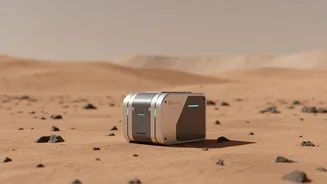
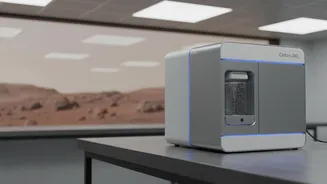
The proof of concept for Martian air production is a lunchbox-sized instrument aboard NASA's Perseverance rover called MOXIE, or the Mars Oxygen In-Situ Resource Utilization Experiment. MOXIE works through solid oxide electrolysis. It pulls in the Martian atmosphere, heats it to around 800 degrees Celsius, and then uses an electrochemical process to split the CO2 molecules into oxygen and carbon monoxide. The oxygen ions are then isolated to produce pure, breathable O2. Between 2021 and 2023, MOXIE successfully ran 16 times, proving the technology works in the harsh Martian environment, including through different seasons and times of day. At its peak, it produced 12 grams of oxygen per hour—roughly the rate of a small tree on Earth—and proved that manufacturing air on another planet is no longer science fiction.
From a Single Tree to a Forest
While MOXIE was a resounding success, its total output of 122 grams is only enough for an astronaut to breathe for a few hours. Scaling up is the next giant leap. Engineers envision a future system that is roughly 200 times larger than the MOXIE demonstrator. Such a plant would need to operate continuously for thousands of hours, producing oxygen at a rate of 2 to 3 kilograms per hour. This wouldn't just be for breathing. The vast majority of the oxygen produced—an estimated 25 metric tonnes—would be used as the propellant oxidizer for the Mars Ascent Vehicle to launch astronauts back to Earth. The life support for the crew would only require about one metric tonne in comparison. This requires moving from a small scientific instrument to a robust, reliable, and largely autonomous industrial chemical plant.
The Power Equation
The single biggest hurdle to scaling up electrolysis is power. Heating and running a large-scale oxygen plant requires a tremendous amount of energy, far more than can be provided by solar panels, which are vulnerable to Mars's planet-encircling dust storms. A full-scale MOXIE-type system is estimated to need between 25 and 30 kilowatts of continuous power. For context, NASA's concepts for an early human outpost with a crew of four to six astronauts estimate a total power need of around 40 kilowatts. The most feasible solution for this level of energy demand is a small-scale nuclear fission reactor. NASA has been developing this technology through its Kilopower project, which has tested reactors capable of providing 1 to 10 kilowatts of electrical power continuously for over a decade. Several of these units working in tandem could power a habitat and its life-sustaining oxygen factory.
The Engineer's Blueprint for Martian Air
Building the full-scale oxygen plant involves significant engineering challenges beyond just the power source. The system will need advanced compressors to gather enough of Mars's thin air and bring it to a pressure usable for electrolysis. The solid oxide electrolysis stacks themselves are being scaled up, with newer designs featuring five times the cell area and many more cells per stack than the version used in MOXIE. Engineers are also working on making the systems more durable and less reliant on complex subsystems, such as by developing new cathode materials that are more resistant to oxidation, which could simplify the overall design and improve reliability. This full-sized oxygen generator would be a heavy piece of equipment, likely weighing around one tonne, and would be sent to Mars ahead of the first human mission to stockpile oxygen for both breathing and rocket fuel.