

A New Star Challenges Old Ideas
When the 'new star' appeared in the constellation Ophiuchus, it was a profound puzzle. The prevailing belief, rooted in Aristotelian philosophy, was that the heavens beyond the Moon were perfect and unchanging. A new star appearing where none was before
was, therefore, impossible. The event was meticulously documented by observers across Europe, China, and Korea, but it was German astronomer Johannes Kepler whose detailed study, 'De Stella Nova' ('On the New Star'), would link his name to the phenomenon forever. Kepler and his contemporary, Galileo Galilei, used the event to argue that changes could and did occur in the heavens, helping to dismantle the old Earth-centric model of the cosmos. They didn't know they were observing a stellar death, but their observations marked a turning point in astronomy.
What Kepler Actually Witnessed
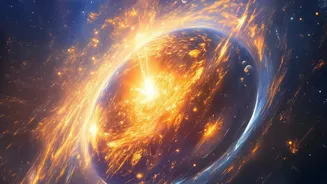
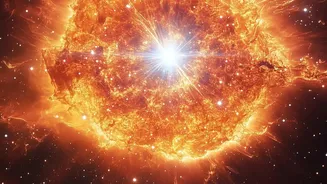
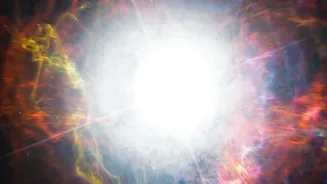
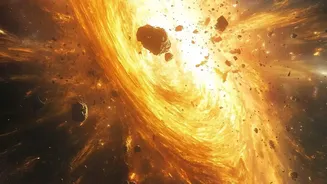
What Kepler and others saw wasn't the birth of a star, but the violent death of one. Modern astronomers have identified SN 1604 as a Type Ia supernova. This specific kind of cataclysm occurs in a binary star system where a small, dense remnant called a white dwarf siphons material from a companion star. When the white dwarf exceeds a critical mass—about 1.4 times that of our sun—it triggers a runaway thermonuclear explosion that completely obliterates the star. Because this mass limit is consistent, Type Ia supernovae have a predictable, uniform peak brightness. This has made them incredibly valuable to modern astronomers as 'standard candles', allowing them to measure vast distances across the universe and even to discover the accelerating expansion of the cosmos.
From Eyeballs to Advanced Optics
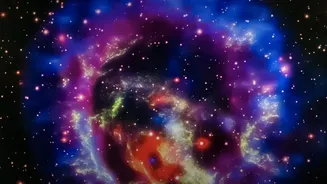
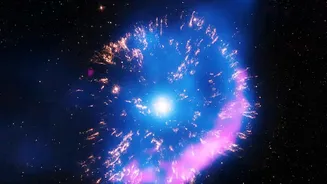
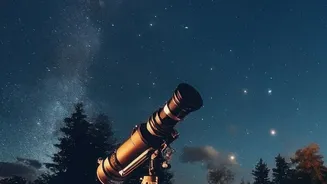
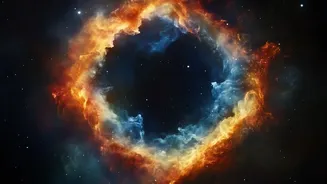
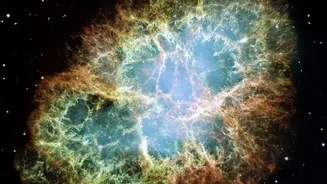
Kepler made his groundbreaking observations with the most basic instrument available: the naked eye. The telescope wouldn't be turned to the skies for another few years. Today, the tools are vastly different. Astronomers study the remnant of Kepler's supernova—an expanding cloud of gas and dust now 14 light-years across—with powerful telescopes that see in ways Kepler couldn't imagine. NASA's Chandra X-ray Observatory, the Hubble Space Telescope, and the Spitzer Space Telescope have all captured stunning images of the remnant, each revealing different aspects of the explosion's aftermath by observing different wavelengths of light, from X-rays to infrared. This multi-wavelength approach allows scientists to piece together the physics of the explosion, map the distribution of elements like iron produced in the blast, and watch the debris expand into space at millions of miles per hour.
The Modern Supernova Hunt
While Kepler had to wait for a supernova to appear in our galactic backyard, modern astronomers are far more proactive. Automated sky surveys, like the Zwicky Transient Facility (ZTF), constantly scan huge patches of the night sky. Using a technique called image subtraction, computers compare new images to old ones, flagging any new points of light that appear. This allows astronomers to catch supernovae in other galaxies within days, or even hours, of their explosion. Once a candidate is found, they follow up with other telescopes to capture its light curve (how its brightness changes over time) and its spectrum (the chemical fingerprint of its light), which helps classify the type of supernova and understand the star that exploded. This systematic hunt yields thousands of discoveries, providing a rich dataset for understanding the lifecycle of stars.