




A Day Longer Than a Year
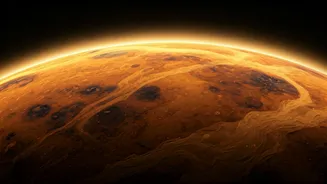
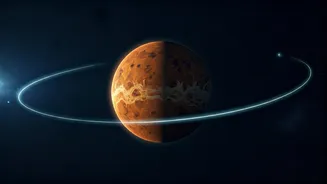
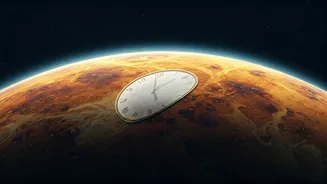
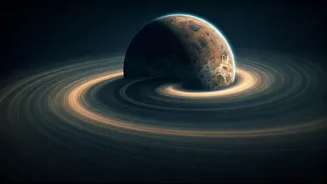
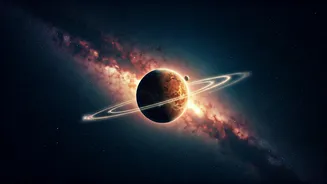
Let's get the mind-bending numbers out of the way first. Venus takes approximately 225 Earth days to complete one orbit around the Sun. That’s its year. However, it takes a staggering 243 Earth days to complete just one rotation on its axis. That’s its day.
This means that if you were standing on Venus, a full year would pass before a single day-night cycle is complete. It’s a concept that feels fundamentally wrong to us, conditioned as we are by Earth’s brisk 24-hour spin and 365-day journey. This unique characteristic makes Venus one of the strangest worlds in our solar system, a planet where the basic rhythm of time is unlike anything we experience.
The Planet That Spins Backwards
Adding to the weirdness is Venus's rotation. While Earth and most other planets in our solar system spin counter-clockwise on their axis, Venus spins clockwise. This is known as retrograde rotation. If you could see the sky through its thick, toxic clouds, you would watch the Sun rise in the west and set in the east. This backward, incredibly slow spin is a crucial part of the puzzle. The combination of its retrograde motion and slow speed creates an even stranger phenomenon: its solar day (the time from one sunrise to the next) is 'only' about 117 Earth days long. This happens because as the planet slowly spins backward, its orbit around the Sun 'catches up' a bit, shortening the time it takes for the Sun to return to the same point in the sky.
The Power of a Thick Atmosphere
So, why is Venus so slow and backward? For years, scientists suspected a cataclysmic event, like a massive asteroid impact in its distant past, knocked it off-kilter. While that remains a possibility, the leading theory now points to something even more persistent: its atmosphere. Venus is shrouded in an incredibly dense atmosphere, about 90 times thicker than Earth's, composed mostly of carbon dioxide. This creates a runaway greenhouse effect, making its surface hot enough to melt lead. This thick atmosphere, heated by the Sun, generates powerful 'thermal tides.' These are not like our ocean tides but are waves of atmospheric pressure that travel around the planet. According to models, these tides create a powerful drag, acting like a constant brake on the planet’s rotation over billions of years, slowing it down to its current crawl.
A Push and Pull Dynamic
The relationship between the solid planet and its thick atmosphere is a complex tug-of-war. The friction between the fast-moving upper atmosphere and the slowly rotating planet creates immense force. Data from space probes like Japan's Akatsuki orbiter have shown that the winds on Venus can whip around the planet in just four Earth days, a phenomenon known as 'super-rotation.' This creates friction at the surface and even generates massive, planet-sized mountain waves that ripple through the atmosphere. The interaction between these powerful atmospheric forces and the planet’s solid core and mantle likely contributes to both the slow spin and its stability. It’s a dynamic equilibrium where the atmosphere dictates the length of the day.