

The Sun’s Inevitable Transformation
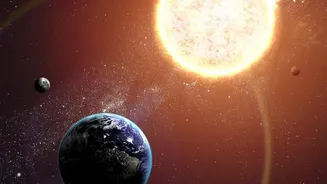
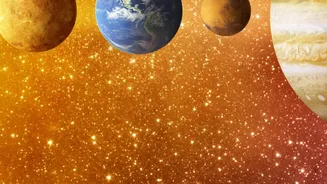
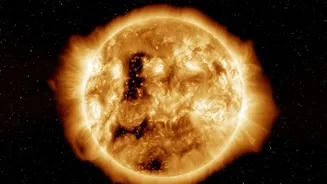
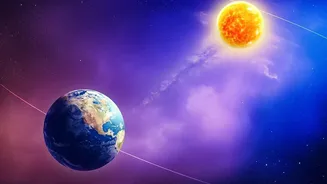
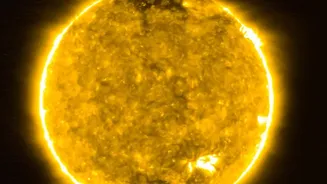
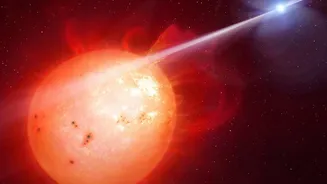
Our Sun, currently a middle-aged star, has been steadily burning hydrogen for about 4.6 billion years. But in another five billion years, that fuel will start to run out. This triggers a dramatic transformation. The Sun will swell into a red giant, its
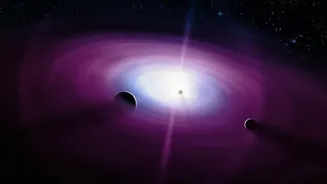
outer layers expanding to a size that will engulf Mercury and Venus, and potentially even Earth. After about a billion years in this bloated state, it will shed its outer layers and collapse into a white dwarf — a dense, Earth-sized remnant of its former self. This process has long been understood as the Sun's final act, but recent studies are focused on what this means for the planets that survive the initial inferno.
A Loosening Gravitational Grip
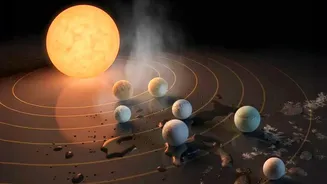
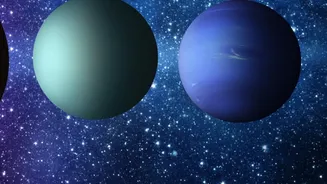
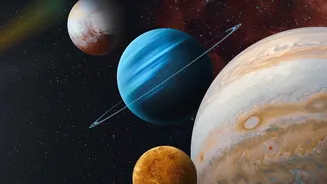
As the Sun becomes a white dwarf, it is expected to lose about half its mass. This significant mass loss weakens its gravitational pull on the remaining planets. Conventional models assumed this process would be smooth and gradual. In that scenario, the outer giants—Jupiter, Saturn, Uranus, and Neptune—would simply drift into wider, but still stable, orbits. For decades, it was thought this new configuration could last for hundreds of billions of years, only to be disrupted by a chance encounter with a passing star. However, new simulations challenge this picture of a peaceful retirement.
Cosmic Billiards in the Outer System
The latest research, detailed in The Astrophysical Journal Letters, introduces a more chaotic element: the Sun may not lose mass smoothly. Instead, it could eject its mass in thousands of uneven, violent bursts. Each of these 'stochastic kicks' would give the dying Sun a slight nudge, creating subtle but significant disturbances in the gravitational balance of the outer solar system. These small perturbations, accumulating over millions of years, can destabilize the finely tuned orbits of the giant planets, turning the orderly system into a game of cosmic billiards.
Saturn's Shocking Exit
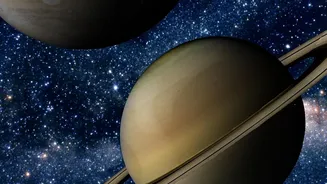
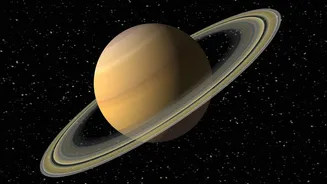
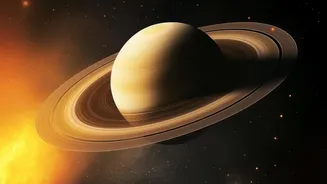
To explore these possibilities, researchers ran hundreds of computer simulations—672 in one key study—to model how the outer planets would react to the Sun's messy final stages. The results were dramatic. In a significant percentage of the simulations, the planetary system descended into chaos. In some scenarios, Uranus and Neptune switched places. Most startlingly, some simulations ended with Saturn, the second-largest planet, being ejected from the solar system entirely. This instability isn't projected to happen in the unimaginably distant future; the models show it could begin within a billion years of the Sun becoming a white dwarf, and in some cases, even during the red giant phase. Around 40% of the simulated systems experienced major disruptions even before the Sun had fully become a white dwarf.
A Probabilistic Future
It is crucial to remember that these are simulations, not certainties. The actual outcome depends on precisely how the Sun loses its mass, a process scientists are still working to understand. However, these findings provide a compelling explanation for a known cosmic mystery: the existence of 'rogue planets', or free-floating worlds that wander through interstellar space without a star to orbit. The ejection of planets from their home systems during a star's death throes could be a common source of these lonely travelers. While the inner solar system is doomed to be scorched and possibly consumed, this research suggests the outer planets face a different, but equally dramatic, fate of gravitational disruption and potential exile.