
What is Space Weather?
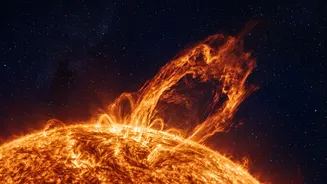
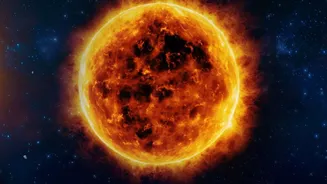
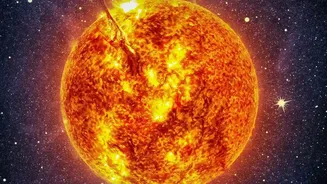
Space weather refers to the changing conditions in space, primarily driven by the Sun's activity. The Sun is not a static, uniformly burning ball of gas; it's a dynamic and magnetically active star. It constantly releases a stream of charged particles
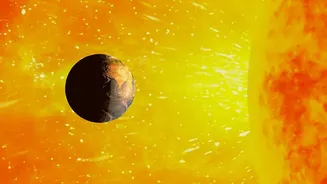
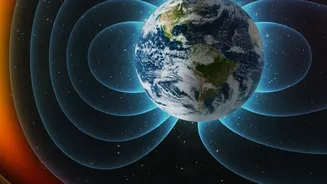
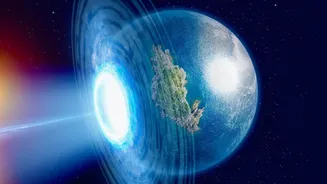
called the solar wind. Sometimes, this activity intensifies dramatically. The Sun can produce sudden, powerful bursts of radiation known as solar flares, which reach Earth at the speed of light. It can also unleash colossal bubbles of plasma and magnetic fields called Coronal Mass Ejections (CMEs). When these massive bursts of energy and particles are directed towards Earth, they interact with our planet's magnetic field and upper atmosphere, creating what we call a solar storm.
The Threat to Our High-Tech World
Our modern society is deeply dependent on technology, making us more vulnerable than ever to the effects of space weather. Severe solar storms pose a multi-pronged threat. They can induce powerful electrical currents in our power grids, which can overload transformers and potentially cause widespread, long-lasting blackouts. Satellites, the backbone of our global communication, navigation (GPS), and weather forecasting systems, are also at high risk. The intense radiation from a storm can damage their sensitive electronics, while the expansion of Earth's atmosphere during an event can create drag, slowing them down and shortening their operational lifespan. Furthermore, these storms can disrupt radio communications, affecting aviation and emergency services.
A Planetary Defence System
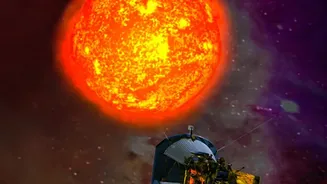
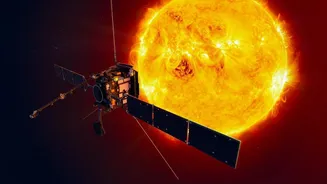
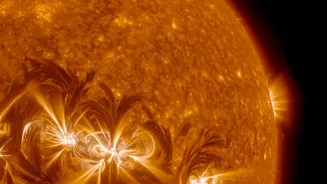
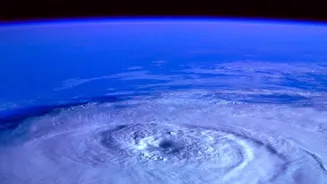
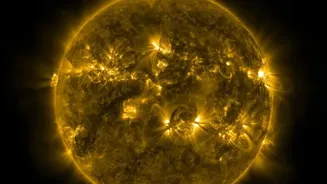
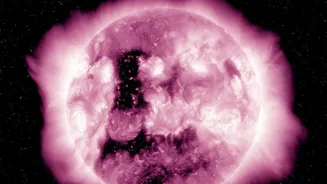
Just as we track hurricanes on Earth, scientists monitor the Sun to forecast space weather. This is not an academic exercise; it's a critical form of planetary defence. A global network of space-based and ground-based observatories keeps a constant watch on the Sun. Spacecraft like NASA's Solar Dynamics Observatory (SDO) and the joint ESA/NASA Solar and Heliospheric Observatory (SOHO) provide high-definition views of the Sun's surface and atmosphere, allowing scientists to spot active regions and solar eruptions. By tracking sunspots—cooler, magnetically intense areas on the Sun's surface—forecasters can gauge the likelihood of a flare or CME. This continuous monitoring provides crucial warning time, sometimes hours or even days, before a storm hits Earth.
India's Eye on the Sun
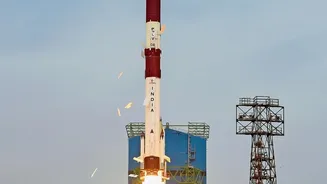
India has become a key player in this global effort with its Aditya-L1 mission. Launched by ISRO, Aditya-L1 is the country's first dedicated solar observatory, strategically positioned at a point in space—Lagrange Point 1 (L1)—where it has an uninterrupted view of the Sun. The mission's instruments are designed to study the Sun's corona, track CMEs, and measure the solar wind before it reaches our planet. This vantage point provides an early warning of potentially hazardous space weather, offering a lead time of 30 to 60 minutes for incoming solar wind disturbances. The data from Aditya-L1 not only contributes to global scientific understanding but is also vital for developing India's own space weather prediction models, helping to safeguard the nation's critical infrastructure, from digital payment systems to disaster management networks.