




A Landmark in Flux
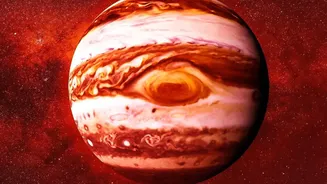
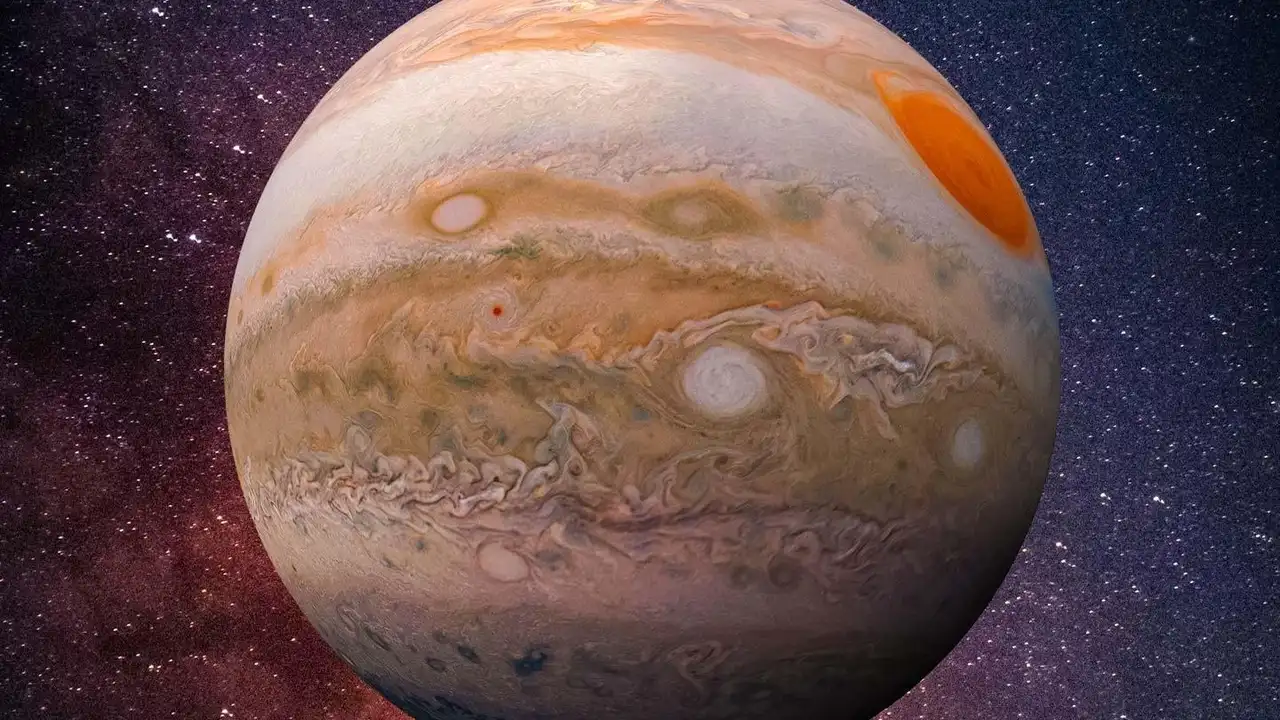
For as long as we have had telescopes powerful enough to see it, the Great Red Spot has been a permanent fixture of Jupiter's southern hemisphere. This gigantic anticyclonic storm, a high-pressure system so vast it could once swallow three Earths, has been observed
since at least the late 1800s. However, data from planetary cameras, particularly the Hubble Space Telescope, confirms a long-term trend: the spot is shrinking. In the late 1970s, NASA's Voyager probes measured it at 23,335 kilometres across. Recent Hubble observations show it has contracted to just under 16,500 kilometres. This downsizing has been accelerating since 2012, with the storm losing about 930 kilometres of its diameter per year and morphing from a distinct oval into a more circular shape.
A Storm of Contradictions
While the storm's overall size is diminishing, its intensity tells a different, more complex story. In a surprising twist, researchers analysing years of Hubble data found that wind speeds in the storm's outer ring are actually increasing. Between 2009 and 2020, the average wind speed in this high-speed lane jumped by up to 8 percent, with gusts exceeding 640 kilometres per hour. At the same time, winds near the storm’s centre are moving much more slowly. More recent observations have added another layer of complexity, revealing that the entire storm appears to be wobbling and fluctuating in size, squeezing in and out on a daily basis in a way never before identified. These rapid changes were unexpected and are currently without a clear hydrodynamic explanation.
What's Driving the Changes?
Scientists are working to understand the forces behind these transformations. One leading hypothesis suggests the storm's accelerated shrinkage could be caused by smaller atmospheric eddies feeding into it. These smaller vortices may be altering the storm's internal dynamics, either sapping its momentum or, conversely, energising it in unexpected ways. Another crucial piece of the puzzle comes from NASA's Juno spacecraft, which has peered deep beneath Jupiter's clouds. Its data revealed that the Great Red Spot is not a shallow feature; its roots plunge at least 320 kilometres into the planet's atmosphere, 50 to 100 times deeper than Earth's oceans. The base of the storm is warmer than its top, a temperature difference that likely fuels its powerful winds. Understanding this deep structure is key to predicting the storm's future.
The Future of a Titan
So, is the Great Red Spot destined to disappear? The answer is uncertain. While the shrinking trend is undeniable, the increasing wind speed and newly discovered oscillations suggest a highly dynamic and energetic system. Some models propose that as the storm becomes smaller, it may also grow vertically, which could make it more vulnerable to being torn apart by Jupiter's powerful jet streams. However, it has survived for at least 150 years in one of the most turbulent atmospheres in the solar system. Jupiter's lack of a solid surface means there's no friction to slow the storm down, which helps explain its remarkable longevity compared to hurricanes on Earth. What is certain is that Jupiter’s most iconic feature is more active and mysterious than ever thought.