


The Peril in Our Orbit
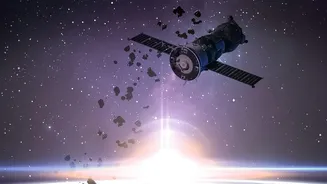
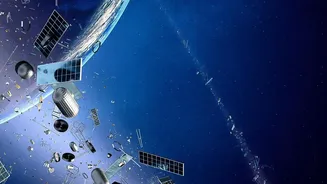
Low Earth Orbit (LEO) is becoming dangerously crowded. For decades, every rocket launch and satellite deployment has left something behind. Today, this has amounted to thousands of defunct satellites, spent rocket stages, and millions of smaller fragments.
This orbital junkyard travels at speeds exceeding 28,000 kilometres per hour. At that velocity, even a small paint chip can strike an operational satellite with devastating force. The services we take for granted — from GPS navigation and weather forecasting to financial transactions and mobile communication — are all reliant on a fragile infrastructure in space. Experts warn of a potential chain reaction, known as the Kessler Syndrome, where one collision creates a debris field that causes more collisions, eventually rendering entire orbits unusable for generations.
A Magnetic Solution Emerges
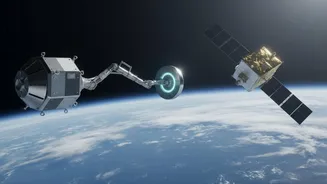
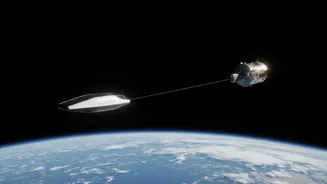
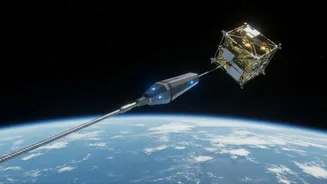
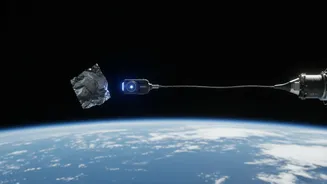
Cleaning up space is one of the most complex engineering challenges of our time. Several methods are being tested, including robotic arms, nets, and even harpoons. However, these 'contact' methods carry risks; a missed capture could create even more debris. This is where magnetic capture systems offer a more elegant solution. These systems aim to use the power of magnetism to capture and de-orbit junk without the need for a high-risk physical grab. The core idea is to create a 'space tug' that can securely latch onto a piece of debris, control it, and then drag it down into Earth's atmosphere, where it will safely burn up upon re-entry. This approach promises a gentler, more controlled, and potentially reusable method for orbital cleaning.
How to Catch a Satellite
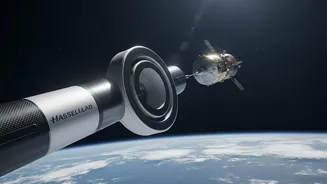
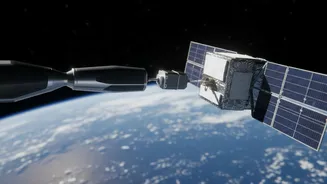
The technology works in two main ways. The most straightforward approach is 'cooperative capture'. Future satellites can be designed with a simple, standardised ferromagnetic plate, essentially a magnetic bullseye. A 'servicer' spacecraft can then approach the satellite at its end of life, activate an electromagnet, and create a secure bond with the plate. This connection is strong but can be easily turned on and off, allowing for precise and safe docking. The bigger challenge is capturing 'non-cooperative' debris—older satellites not designed for removal. For these targets, which make up the vast majority of existing junk, engineers are developing more advanced techniques. One method involves using powerful, rotating magnetic fields from the servicer to induce electrical currents (called eddy currents) within the metallic body of the debris. This turns the debris itself into a temporary electromagnet, allowing the servicer to manipulate it from a distance without ever touching it.
The Pioneers of Orbital Cleaning
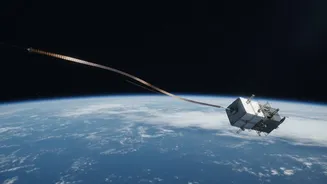
This technology is moving rapidly from theory to reality. The Japanese company Astroscale is a global leader in this field. Its ELSA-d mission successfully demonstrated the key technologies for magnetic docking in orbit. The mission involved a 'servicer' satellite repeatedly releasing and recapturing a 'client' satellite using a magnetic mechanism, proving the viability of the concept for future services. Astroscale is now developing its next-generation ELSA-M servicer, designed to capture multiple defunct satellites in a single mission. Other entities like the European Space Agency (ESA) are also heavily invested. ESA commissioned the Swiss company ClearSpace to develop a mission to remove a large piece of debris, signalling a growing commercial market for these essential environmental services for space.
The Hurdles to a Cleaner Space
Despite the technological promise, significant challenges remain. The first is cost. Developing, launching, and operating these cleanup missions is incredibly expensive, and questions about who should pay for removing legacy debris are still being debated. Secondly, the technology is not a silver bullet; it is most effective on specific types of debris, and capturing large, non-metallic, or unpredictably tumbling objects remains a monumental task. Finally, there are complex legal and geopolitical hurdles. Removing a defunct satellite, even if it is just junk, could be perceived as a hostile act if it belongs to another nation. Clear international agreements and regulations are urgently needed to govern these activities and prevent misunderstandings in the already sensitive domain of space.