





The Great Divide: Front-of-Pack vs. Back-of-Pack
The front of a food package is prime real estate for marketing. Brands use appealing words and images to grab your attention and influence your decision. This is where you'll find bold claims designed to make a product seem healthier than it might be.
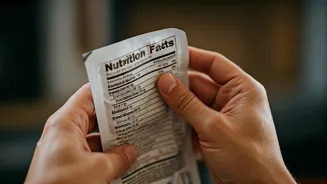
However, the real story is on the back. The Food Safety and Standards Authority of India (FSSAI) mandates that all packaged foods display a nutrition information panel and a list of ingredients. This is where the facts live, away from the flashy promises. Recently, the FSSAI has even issued notices to several companies for using misleading terms like "healthy" or "natural" on their packaging, highlighting just how widespread this issue is. The front sells the story; the back tells the truth.
Decoding Common Health Buzzwords
Many of the most common health claims are vague and poorly regulated, leaving them open to interpretation. "Natural," for instance, often just means a product started with a natural source, but doesn't account for extensive processing. Similarly, a product labelled "multigrain" might sound healthier than one made with whole wheat, but it often means several different grains are present, with the primary one being refined flour (maida). Claims like "made with real fruit" can be deceiving, as a product might contain a very small amount of fruit concentrate while being loaded with sugar. The term "organic" is also frequently misused; unless a product carries the official Jaivik Bharat logo, the claim may be unverified.
The Low-Fat, No-Sugar Trap
Claims about fat and sugar are particularly tricky. When fat is removed from a product to label it "low-fat," something else is often added to improve the taste and texture—and that something is usually sugar or sodium. On the flip side, "no added sugar" doesn't mean the product is sugar-free. It simply means no extra sugar was added during processing. The product could still be high in naturally occurring sugars, like those found in fruit juice concentrates, which the body processes in the same way. A product labelled "sugar-free" must legally contain less than 0.5 grams of sugar per serving, but may contain artificial sweeteners.
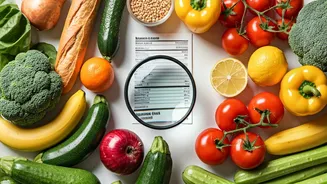
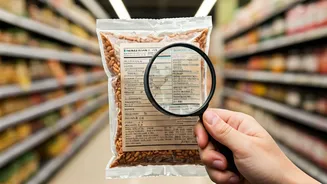
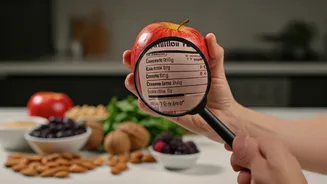
Your Secret Weapon: The Nutrition Label
Learning to read the nutrition label is the single best skill for seeing past the marketing. Here’s what to focus on. First, check the ingredients list. Ingredients are listed in descending order by weight, so the first three to five ingredients make up the bulk of the product. If sugar, maida, or hydrogenated oils are near the top, it's a red flag. Second, look at the 'per 100g' column, not just the 'per serving' size, which can be unrealistically small. This allows for a fair comparison between products. As a general rule, watch out for products with more than 15g of sugar or 600mg of sodium per 100g.
Putting It All Together in the Aisle
Let’s apply this. You're comparing two types of breakfast cereal. One has a cartoon mascot and claims to be “fortified with vitamins.” The other has a simple design and says “100% whole grain.” You flip them over. The cartoon cereal lists sugar as the second ingredient and has 25g of sugar per 100g. The whole grain option lists “whole wheat flakes” first and has only 5g of sugar per 100g. Another example is biscuits. A packet of “digestive” biscuits may sound healthy, but the ingredient list often starts with maida and palm oil, with significant amounts of added sugar. In contrast, a true whole-grain cracker will list whole wheat flour first and have minimal sugar. By ignoring the front and heading straight for the back, you empower yourself to make a genuinely healthier choice.