


From Satellites to Smartphones
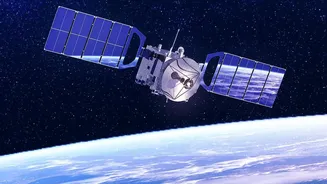
For years, Starlink has been synonymous with bringing high-speed internet to remote and underserved areas using a vast constellation of satellites. But its ambitions are evolving. The company is now focused on 'Direct to Cell' technology, a service designed
to connect satellites directly to standard, unmodified smartphones. This isn't about replacing your home Wi-Fi anymore; it's about providing a mobile signal anywhere on Earth, effectively turning its satellites into cell towers in the sky. The initial service, which has already started rolling out in some countries, focuses on text messaging, with voice and data capabilities planned for the near future. This strategic shift positions Starlink not just as an internet provider, but as a future global mobile network.
The Crucial Spectrum Deal
To make this satellite-to-phone connection work, Starlink can't simply beam signals down. It needs access to spectrum—the invisible radio wave frequencies that carry mobile data. Historically, Starlink has partnered with existing mobile operators like T-Mobile in the US, essentially 'leasing' their spectrum to fill in coverage gaps. However, a recent move shows a change in strategy. On October 8, 2026, SpaceX announced an agreement to acquire its own nationwide low-band spectrum in the US from an investment firm. Owning spectrum is a game-changer. It means Starlink would no longer have to rely solely on partners and could build its own independent network, giving it the foundation to operate as a standalone carrier.
A Competitor or a Partner?
The headline's claim that Starlink could become a 'larger carrier' hinges on this strategy of owning spectrum. By acquiring these assets, SpaceX is signalling it wants to be more than just a backup service for when your regular phone has no signal. Elon Musk stated the deal provides the 'last critical piece of the spectrum puzzle' for complete phone coverage. The goal is a hybrid network where a user's phone could seamlessly switch between a terrestrial signal on the ground and a satellite signal from space. Initially, this still looks like a partnership model, but the long-term ambition is clear: to compete directly with giants like AT&T and Verizon in the US. The news sent shares of major US telecom companies tumbling, a clear sign that the industry is taking the threat seriously.
What This Means for India
In India, the situation is more complex. Starlink has secured a key licence but is still awaiting final regulatory approvals, including for security and spectrum allocation, before it can launch commercially. The company faces a market dominated by highly affordable data plans from giants like Reliance Jio and Bharti Airtel, both of which are also developing their own satellite internet ventures. Elon Musk has recently claimed that Starlink is being blocked by 'oligarchs' trying to maintain a 'monopolistic chokehold', an allegation the Indian government has called 'baseless'. For Starlink to succeed in India, its primary role will likely not be to compete on price in urban areas, where fibre broadband is already cheap. Instead, its 'Direct to Cell' service could be a revolutionary tool for connecting the vast, remote parts of the country where building traditional cell towers is economically unfeasible, finally bringing reliable connectivity to millions.