




The Cosmic ‘Missing Link’
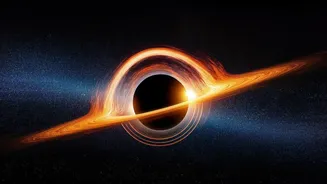
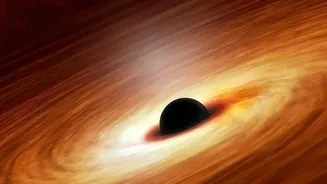
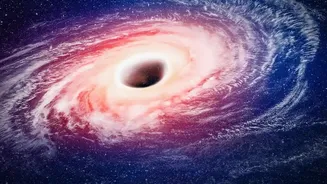
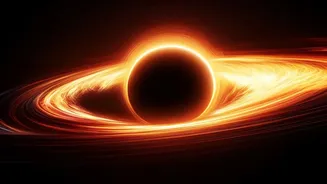
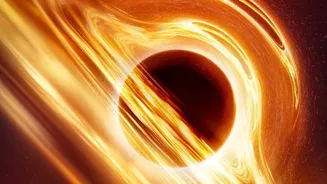
For decades, our understanding of black holes felt like a story with a missing chapter. Astronomers had mountains of evidence for two main types: stellar-mass black holes, which are a few dozen times the mass of our sun, and the supermassive behemoths
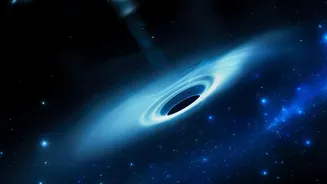
at the centres of galaxies, weighing millions or even billions of times more. But the space between these two extremes was eerily empty. Scientists theorised the existence of Intermediate-Mass Black Holes (IMBHs), objects with masses between 100 and a million times that of the sun. These IMBHs were considered a crucial 'missing link'—the potential seeds from which supermassive black holes grow. Finding them, however, proved incredibly difficult, leaving a significant gap in our understanding of how galaxies and their cosmic engines evolve. This new discovery provides the first direct, unambiguous evidence of these elusive objects colliding.
Hearing the Universe’s Whispers
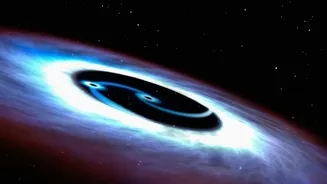
So, how do you see something that, by definition, traps all light? You don't see it; you listen for it. When two massive objects like black holes spiral towards each other and merge, they create a cataclysmic event that sends ripples through the very fabric of spacetime. These are gravitational waves, first predicted by Albert Einstein over a century ago. Imagine spacetime as the smooth surface of a pond. A black hole merger is like dropping two massive bowling balls into it, creating waves that travel outward at the speed of light. By the time these waves reach Earth billions of light-years later, they are incredibly faint—distorting spacetime by less than the width of a proton. Detecting such a minuscule disturbance requires some of the most sensitive scientific instruments ever built.
A Global Network of Cosmic Ears
The detection was made possible by a global network of advanced gravitational-wave observatories. Facilities like the Laser Interferometer Gravitational-Wave Observatory (LIGO) in the United States, Virgo in Italy, and KAGRA in Japan work in concert. Each observatory consists of enormous L-shaped tunnels, kilometres long, through which powerful lasers are bounced between mirrors. A passing gravitational wave minutely stretches and squeezes the length of these arms, a change that the detectors can measure with astonishing precision. By combining data from multiple locations, scientists can not only confirm a signal is real and not just local noise, but also triangulate its origin in the sky, pointing telescopes toward the source to search for any associated light—a practice known as multi-messenger astronomy.
Why This Discovery Matters
Confirming IMBH mergers is more than just ticking an item off the astronomical wish list. It provides a direct pathway to understanding how the universe's largest structures came to be. It suggests that supermassive black holes may have grown through a process of hierarchical mergers, starting with smaller black holes that combined over cosmic time to form IMBHs, which then continued to merge and grow. Each detection is a fossil record of the universe, allowing us to test the limits of Einstein's theory of general relativity in the most extreme environments imaginable. This new population of black holes opens an unprecedented window into the very first stars that lit up our universe, as these early, massive stars are one potential origin for the seeds of IMBHs.
India’s Role in the New Wave of Astronomy
This new era of astronomy has a significant Indian connection. The next major instrument to join the global network will be LIGO-India, currently under construction in the Hingoli district of Maharashtra. Scheduled to become the fifth major gravitational wave observatory in the world, LIGO-India will dramatically enhance the network's capabilities. Its strategic location, distant from the other detectors, will vastly improve the ability to pinpoint the location of cosmic events in the sky. This precision is crucial for follow-up observations. The project, led by a consortium of Indian research institutions, positions India at the forefront of fundamental physics and astrophysics research, promising a future where Indian scientists play a central role in decoding the universe's deepest secrets.