


A New Window to the Universe
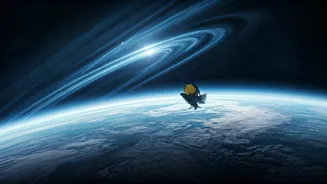
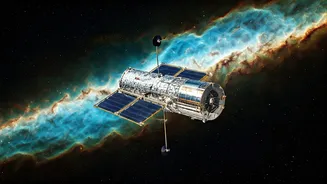
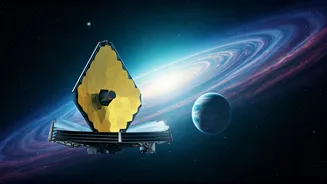
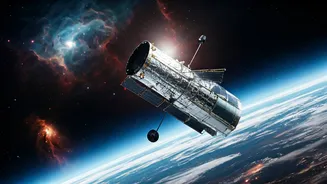
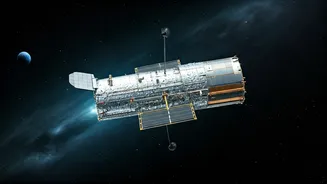
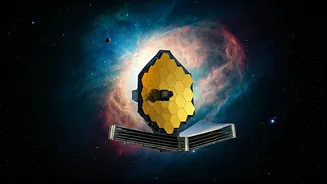
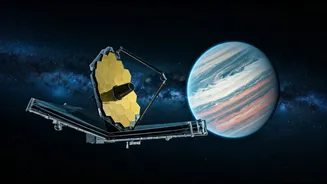
To appreciate what the James Webb Space Telescope does, it helps to understand how it does it. Unlike its famous predecessor, the Hubble Space Telescope, which sees the universe primarily in visible and ultraviolet light, JWST is designed to see in infrared.
This is a critical difference. Infrared light can pierce through cosmic dust clouds that would otherwise obscure our view, allowing us to see stellar nurseries where new stars and planets are being born. Perhaps more importantly, because the universe is expanding, light from the most distant objects gets stretched into longer, redder wavelengths over its journey across billions of years. JWST's giant, gold-coated mirror is specifically designed to capture this faint, ancient light, effectively making the telescope a powerful time machine. It can look back to the cosmic dawn, a period just a few hundred million years after the Big Bang, to witness the formation of the very first galaxies.
Tasting the Air of Alien Worlds
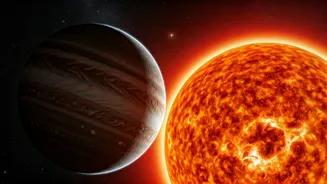
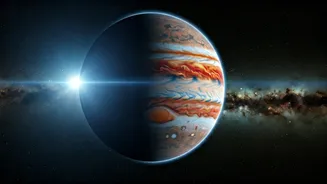
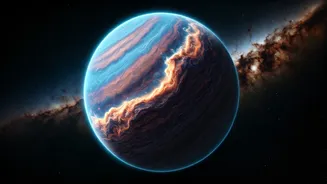
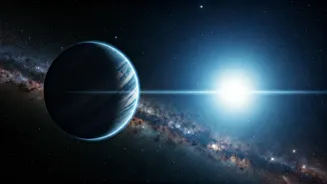
One of the most profound ways Webb makes distant worlds feel real is by analysing their atmospheres. When a planet passes in front of its star, a tiny fraction of the starlight filters through the planet’s atmosphere. JWST can 'read' this light to determine what chemicals are present. Recently, the telescope studied the exoplanet WD 1856 b, a Jupiter-sized world orbiting a dead star known as a white dwarf. Webb detected the telltale signs of small cloud particles and hydrocarbons, likely methane, marking the first time an atmosphere has been detected on a planet transiting a dead star. By studying these chemical fingerprints, scientists can look for water, methane, and other molecules that could hint at a world's potential for life. This is no longer science fiction; it is a new, powerful capability that moves alien planets from the realm of artists' concepts into the world of tangible data.
Rewriting the Cosmic History Books
Before JWST, our theories about the early universe were just that—theories. Now, Webb is providing the observations to test them, and in many cases, is forcing a rewrite. Scientists were astounded to find galaxies in the early universe that were far larger, brighter, and more developed than models had predicted. In one recent discovery, astronomers using Webb spotted a massive and densely packed galaxy cluster, XLSSC 122, as it was just 3.4 billion years after the Big Bang—a time when such mature structures weren't thought to be possible. In another, it captured a protocluster of at least six galaxies in the process of merging to form one massive galaxy just 1.5 billion years after the universe began. These findings challenge our understanding of how quickly galaxies and the supermassive black holes at their centres can grow, sending theorists back to the drawing board to figure out how these cosmic giants formed so early and so fast.
A Glimpse of Our Own Future
While famous for peering into the distant past, JWST also provides a unique glimpse into the distant future—including the potential fate of our own solar system. The aforementioned study of WD 1856 b is a prime example. The planet orbits its tiny, dead star at a distance 50 times closer than Earth orbits the Sun. It should have been destroyed when its star swelled into a red giant before collapsing. Its survival and current tight orbit provide a window into what might happen to planets like Jupiter billions of years from now, after our Sun dies. One scientist called it 'using a time machine to peer into the distant future of our solar system.' This ability to study not just the beginning of time but also the end-states of planetary systems makes the universe feel like a place with a life cycle, not just a static backdrop.