







India’s Next Frontier in Space
The Indian Space Research Organisation (ISRO) is embarking on a transformative journey, shifting from shorter missions to establishing a sustained human presence in space. This new chapter is heavily focused on scientific research, particularly in the
unique environment of microgravity. Key upcoming projects include the Gaganyaan programme, which will send Indian astronauts into orbit, and the planned Bharatiya Antariksha Station (BAS), a modular space station expected to be operational by 2035. These platforms are not just about planting a flag in space; they are sophisticated laboratories designed to conduct cutting-edge experiments that are impossible to perform on Earth. ISRO has already begun soliciting proposals from the national science community for experiments in fields ranging from biology and medicine to materials science, indicating a clear strategy to harness space for terrestrial benefits.
What Is Microgravity, Really?
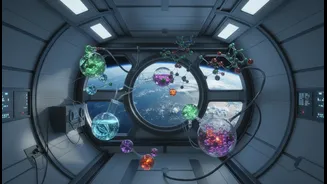
Often mistaken for "zero gravity," microgravity is a condition where the effects of gravity are drastically reduced, creating a state of near-weightlessness. This environment is achieved when a spacecraft is in orbit, as it is in a constant state of free-fall around the Earth. On our planet, gravity is a dominant force, causing denser particles to settle and lighter fluids to rise—a phenomenon called sedimentation and buoyancy. In a microgravity environment, these forces virtually disappear. Particles remain suspended, and fluids mix differently, dominated by weaker forces like surface tension. This seemingly simple change unmasks fundamental physical and biological processes, allowing scientists to observe them with unprecedented clarity. It creates a pristine laboratory setting for exploring the very building blocks of matter and life.
A Laboratory for Medical Miracles
One of the most promising areas for microgravity research is medicine and biotechnology. On Earth, gravity causes cells to grow in flat, two-dimensional layers. In space, however, cells can grow into three-dimensional structures that more closely resemble how they behave inside the human body. This is a game-changer for studying diseases like cancer, as it allows researchers to observe how tumours grow and respond to drugs in a more realistic model. The environment also helps in growing larger, more perfect protein crystals, which is crucial for drug development. By understanding a protein's exact structure, scientists can design highly targeted medicines with fewer side effects. Furthermore, studying the health effects on astronauts, such as bone density loss and muscle atrophy, provides insights into ageing and diseases like osteoporosis back on Earth.
Building the Materials of Tomorrow
Beyond biology, microgravity is a revolutionary tool for materials science. Without gravity causing sedimentation, it becomes possible to create unique metal alloys with perfectly uniform compositions. Imagine materials that are both stronger and lighter than anything we can currently produce, with applications in aerospace, automotive, and energy industries. The near-weightless environment is also ideal for manufacturing flawless optical fibres and semiconductor crystals. On Earth, tiny defects caused by gravity can limit the performance of these crucial components. In space, crystals can grow larger and with fewer imperfections, paving the way for next-generation electronics and faster communication networks. This research could lead to breakthroughs that power our future technologies.
Paving the Way for a Future in Space
ISRO’s focus on microgravity is a strategic investment in India’s future, both in space and on the ground. The research conducted on missions like Gaganyaan and aboard the future Bharatiya Antariksha Station will not only yield scientific discoveries but also build critical capabilities. These missions will serve as testbeds for advanced life support systems, essential for long-duration human spaceflight. The experiments, covering everything from crew nutrition by sprouting seeds to studying how microalgae survive, are foundational for India's long-term ambitions, including a crewed lunar mission by 2040. By nurturing a domestic ecosystem for microgravity research, ISRO is positioning India as a key player in the next era of space exploration and innovation.