





An Indian-Origin Astronaut's Journey
Anil Menon, a colonel in the U.S. Space Force and former flight surgeon for SpaceX, is not your average astronaut. Born to parents from India and Ukraine, his path to the stars was paved with a unique blend of medical expertise and frontline experience.
Before being selected by NASA in 2021, Menon was instrumental in developing SpaceX’s medical program and has experience as an emergency medic in extreme environments, from the battlefields in Afghanistan to caring for climbers on Mount Everest. This background makes him uniquely qualified for the challenges of long-duration spaceflight. On July 14, 2026, he embarked on his first spaceflight, launching from the Baikonur Cosmodrome for an eight-month stay aboard the International Space Station (ISS).
The Perils of Deep Space Travel
A trip to Mars isn’t a weekend getaway; it’s a multi-year voyage fraught with danger. Beyond the initial challenge of getting there, astronauts face a constant barrage of cosmic radiation, the bone-weakening and muscle-wasting effects of microgravity, and profound psychological stress. Medical emergencies that are treatable on Earth, like a ruptured appendix or a serious infection, could be fatal millions of kilometres away. Future deep-space missions require a new level of self-sufficiency, where crews can diagnose and treat illnesses, manufacture supplies, and maintain their health without immediate support from Mission Control. Every long-duration mission on the ISS is a dress rehearsal for this future, a chance to solve these problems before we leave Earth’s orbit for good.
A Floating Laboratory for Mars
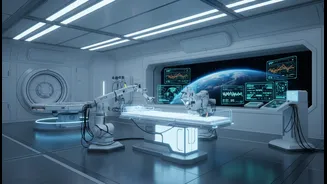
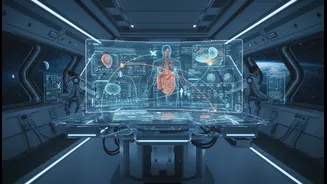
Menon’s eight-month mission, part of Expedition 75, transforms the ISS into a crucial proving ground for Mars-bound technologies. His medical background will be put to direct use as he helps conduct experiments that tackle the core challenges of deep-space health. One key experiment involves using ultrasound enhanced with augmented reality and artificial intelligence. The goal is to create a system that allows astronauts with minimal medical training to perform complex scans, guided by an AI, effectively eliminating the need for a doctor on the ground. He will also test technologies to produce intravenous (IV) fluids from the station’s own water supply, a critical step towards medical independence on a long journey.
Bioprinting and Bleeding-Edge Science
The research extends beyond immediate medical care. Menon is slated to be a test subject himself, helping scientists understand how spaceflight affects blood flow to protect future astronauts. He will also be involved in cutting-edge experiments like testing the bioprinting of vascular (blood vessel) constructs in microgravity. This research could not only advance therapeutic developments for use on Earth but is a foundational step towards one day being able to print tissues or even simple organs to treat injuries in space. Other experiments under his purview include refining the in-space manufacturing of semiconductor crystals, which could lead to better computers and medical devices both in orbit and on the ground.
A Doctor in the Cosmos
Menon’s role as both a researcher and a highly trained physician embodies the next phase of human space exploration. For decades, astronauts were primarily pilots and engineers. Now, as we plan for extended stays far from Earth, the presence of crew members with deep medical and scientific expertise is becoming essential. His work during this mission will provide invaluable data on the human body's response to prolonged weightlessness and isolation. More importantly, the technologies he helps validate—from AI-driven diagnostics to on-demand medical supplies—will become the standard of care for the first generation of Martian explorers.