







The Problem with Sitting All Day
Our bodies were designed for movement, but modern work life, especially in bustling Indian cities, often confines us to a chair for eight or more hours a day. This prolonged sitting has a predictable effect: it lulls the largest muscles in our body—the
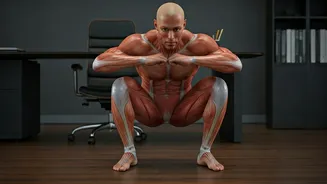
glutes, hamstrings, and quads—into a state of inactivity. This is sometimes called 'gluteal amnesia' or 'dead butt syndrome,' where your glutes essentially forget how to fire correctly. Over time, this can lead to poor posture, lower back pain, and reduced mobility. The lack of movement also restricts blood flow, causing that familiar 'sleepy' or numb sensation in your lower body. The good news is that you can counteract this without ever leaving your workstation.
Exercise 1: The Seated Leg Extension
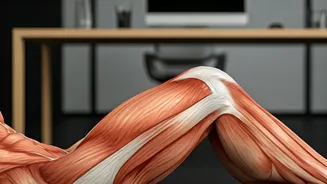
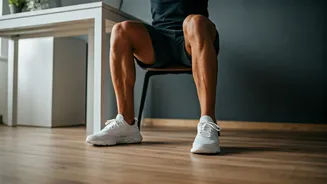
This is a fantastic and discreet way to wake up your quadriceps, the large muscles at the front of your thighs. It requires no equipment and can be done while you're on a phone call or reading emails. **How to do it:** 1. Sit tall in your chair with your back straight and your feet flat on the floor. 2. Slowly extend one leg straight out in front of you until it is parallel to the floor. Keep your thigh on the chair. 3. Hold the position for 3 to 5 seconds, focusing on squeezing your quad muscle. 4. Gently lower your foot back to the starting position. 5. Repeat 10-15 times on one leg before switching to the other. Aim for two sets on each side.
Exercise 2: The Glute Squeeze
This exercise is your secret weapon against 'dead butt syndrome.' It directly targets the gluteal muscles, reminding them to stay active and engaged. Best of all, it's completely invisible to anyone around you. **How to do it:** 1. While seated upright in your chair, simply squeeze your gluteal (buttock) muscles as tightly as you can. 2. Hold the contraction for 5-10 seconds. You should feel your body lift slightly in the chair. 3. Release the squeeze and relax for a few seconds. 4. Repeat this 15-20 times. You can do this several times throughout the day, especially if you feel yourself starting to slouch.
Exercise 3: Seated Calf Raises
Your calves are crucial for circulation in your lower legs, acting as a 'second heart' to help pump blood back up to your chest. Keeping them active can prevent blood from pooling and reduce stiffness in your ankles. **How to do it:** 1. Sit with your feet flat on the floor, keeping your knees bent at a 90-degree angle. 2. Slowly lift your heels off the floor as high as you can, pressing through the balls of your feet. Your toes should remain on the ground. 3. Hold the peak position for a moment, feeling the contraction in your calf muscles. 4. Lower your heels back down in a controlled manner. 5. Perform 20 repetitions. For an extra challenge, you can place a heavy book on your knees.
Exercise 4: Ankle Rotations
Stiff ankles are a common side effect of keeping your feet in one position all day. Ankle rotations improve flexibility and boost blood flow to your feet, helping to ward off that pins-and-needles sensation. **How to do it:** 1. Lift one foot slightly off the floor. 2. Slowly rotate your foot in a clockwise circle from the ankle. Make the circles as large as you comfortably can. 3. Complete 10-15 rotations in one direction. 4. Reverse the direction and perform another 10-15 rotations counter-clockwise. 5. Switch feet and repeat the entire sequence. This is a great exercise to do every hour.
Making It a Daily Habit
The key to seeing benefits from these exercises is consistency. Firing up your muscles once a week won't be enough to combat hours of daily sitting. Try to integrate these movements into your routine. Set a timer on your phone or computer to remind you to move every 45-60 minutes. Pick one exercise to do every time you finish a task or start a new one. You can even combine them; for example, do glute squeezes while performing leg extensions. Start small, and soon it will become a natural part of your workday, helping you feel more energised and less stiff.