



![[WATCH] Virat Kohli wins hearts with touching gesture towards specially-abled Pakistani fan outside Lord’s](https://g-mob.glance-cdn.com/public/fc/image/ZUbnunc4YJr0.webp)


An Expedition and a Curious Find
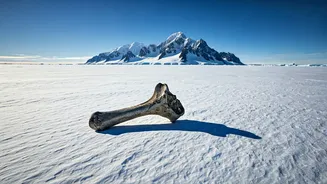
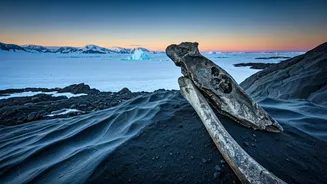
The story begins in December 1985 on James Ross Island, a rugged outpost off the Antarctic Peninsula. A team from the British Antarctic Survey (BAS) was navigating the harsh, frozen landscape, not to hunt for dinosaurs, but to map the region's rock layers.
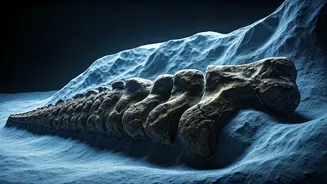
Geologist Dr. Mike Thomson stumbled upon a fragment of bone. In his field notebook, he sketched the 10-centimeter-wide fossil and labeled it simply as a “vertebra of large reptile.” Given that the bone was found in marine rock, the logical assumption was that it belonged to an ancient sea creature, like many other fossils in the area. With its identity unclear, the bone was packed up, sent to Cambridge, and placed into storage at the BAS, where it would remain out of sight for decades.
A Second Look in a Crowded Drawer
For almost four decades, the bone sat among thousands of other geological specimens. Its moment of rediscovery came when Dr. Mark Evans, a paleontologist and the collections manager at BAS, was sorting through the archives. He spotted the vertebra and immediately suspected it was something special. Its shape just didn’t seem to fit with a marine reptile; it looked distinctly dinosaur-like. Realizing the significance of the 1985 collection date, Evans knew this could be the very first dinosaur fossil found on the continent. To confirm his hunch, he contacted Professor Paul Barrett, a dinosaur specialist at London's Natural History Museum.
Confirmed: A Titanosaur from the Antarctic Forest
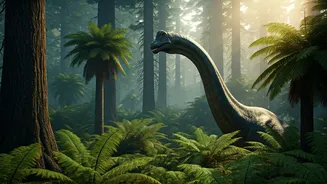
Professor Barrett knew what he was looking at almost instantly. The bone had a unique ball-and-socket structure characteristic of a very specific group of dinosaurs: the titanosaurs. These long-necked, plant-eating sauropods were some of the largest animals to ever walk the Earth, with some species weighing over 15 tonnes. This particular individual, however, was estimated to be a more modest six to seven metres long. The fossil was dated to the Late Cretaceous period, about 82 million years ago. At that time, Antarctica was a world away from the frozen wasteland we know today. It was covered in lush, temperate forests, warmed by volcanic activity—a perfect habitat for a giant herbivore.
Rewriting the History Books
While other Antarctic dinosaur fossils had been found and named in the years since 1985, this re-identified vertebra officially takes the title of the first one ever discovered. For years, a 1986 discovery of an armored dinosaur, Antarctopelta oliveroi, was considered the first. Ironically, Antarctopelta was also found on James Ross Island by Argentinian geologists. The confirmation of the titanosaur fossil is more than just a historical correction. It provides a crucial piece in the puzzle of how dinosaurs spread across the southern continents. During the Late Cretaceous, Antarctica was a land bridge connecting what is now South America and Australia, which were once part of the supercontinent Gondwana. The presence of titanosaurs in Antarctica makes it much more likely that they used this route to migrate to other regions like New Zealand and Australia, where their fossil record is sparse.