





What Exactly Is El Niño?
El Niño, which means "the little boy" or "Christ child" in Spanish, was named by fishermen off the coast of South America who noticed that a strange warming of their coastal waters often peaked around December. It is the warm phase of a larger phenomenon
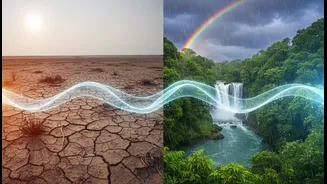
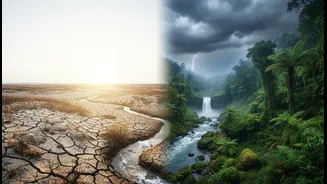
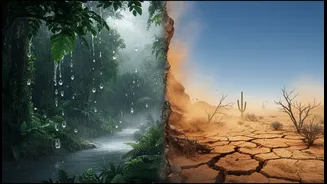
called the El Niño-Southern Oscillation (ENSO). In simple terms, El Niño is the large-scale, abnormal warming of sea surface temperatures in the central and eastern equatorial Pacific Ocean. This isn't a minor temperature shift; it's a significant change that lasts for months, disrupts ocean currents, and, most importantly, alters atmospheric circulation and weather patterns across the globe.
The Science: A Disrupted See-Saw
Under normal conditions, strong trade winds blow from east to west across the Pacific, piling up warm surface water in the western Pacific, near Indonesia and Australia. This allows cooler, nutrient-rich water to rise from the depths along the coast of South America. This atmospheric process is known as the Walker Circulation. During an El Niño event, these trade winds weaken or even reverse. As a result, the massive pool of warm water doesn't get pushed west. Instead, it spreads eastward across the Pacific. This shift in warm water changes where heat and moisture rise into the atmosphere, effectively rerouting the world's weather systems. The area of high pressure normally over the eastern Pacific weakens, and the low-pressure zone in the west shifts, disrupting the entire atmospheric see-saw.
The All-Important Monsoon Connection
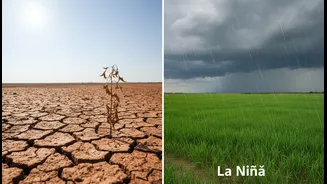
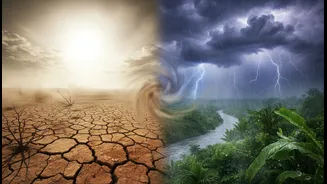
For India, the health of the monsoon is inextricably linked to this Pacific dance. The Indian monsoon is a massive sea-breeze system driven by the temperature difference between the hot landmass of the subcontinent and the cooler Indian Ocean. El Niño throws a spanner in the works. The warming of the Pacific creates changes in air pressure that can suppress the formation of low-pressure systems over India, which are essential for drawing in moisture-laden monsoon winds. It weakens the entire monsoon circulation, leading to less rainfall over the Indian subcontinent. Historically, there's a strong correlation: many of India's most severe droughts have occurred in El Niño years, such as 1987, 2002, and 2015. About half of all El Niño years have resulted in monsoon droughts in India.
From Fields to Food Prices
The impact of a weak monsoon is felt across the country. With about half of India's farmland being rain-fed, a rainfall deficit directly hits the Kharif (summer) crop output, affecting staples like rice, pulses, and oilseeds. This can lead to lower farm incomes, reduced rural demand, and significant stress on the agricultural sector, which employs nearly half the country's workforce. The economic fallout doesn't stop at the farm gate. Lower agricultural output can fuel food price inflation, impacting household budgets across urban and rural areas and posing a challenge for the broader economy.
Meet La Niña, The Cooler Sister
ENSO also has a cold phase, known as La Niña ("the little girl"). It is essentially the opposite of El Niño. During La Niña, the trade winds are even stronger than usual, pushing more warm water toward the western Pacific and causing an upwelling of cold water in the eastern Pacific. For India, La Niña is often good news. The conditions it creates are generally associated with a stronger-than-average monsoon, often leading to ample rainfall and sometimes even floods. These two opposing phases cycle irregularly every two to seven years.
What Is the Current Outlook?
As of July 2026, forecasts from international agencies like the World Meteorological Organization (WMO) indicate that a strong El Niño event is developing and expected to intensify through the remainder of the year. Some models suggest it could become a historically strong event. In India, after a significant rainfall deficit in June 2026, the forecast for July also points towards below-normal rainfall. This has prompted warnings from officials about the potential impact on Kharif crops, especially in regions heavily dependent on monsoon rains. However, it's crucial to remember that El Niño's impact isn't always uniform, and other factors like the Indian Ocean Dipole (IOD) can sometimes offset its effects.