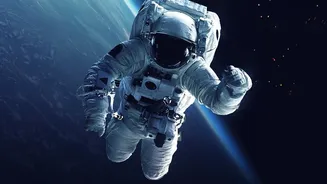

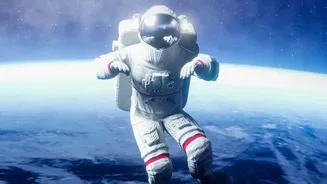
Space is the most hostile environment imaginable. A vacuum with no air, wild temperature swings, and a constant shower of radiation. So how do astronauts survive? The answer is a marvel of engineering: the Extravehicular Mobility Unit, or EMU.
A Personal, Human-Shaped Spacecraft
It's best
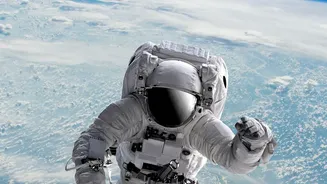
to think of a modern spacesuit not as clothing, but as a personal, human-shaped spacecraft. Its primary job is to create a tiny, habitable bubble around an astronaut, providing everything the Earth’s atmosphere and a vehicle on the ground would. Without it, a person in the vacuum of space would lose consciousness in under 15 seconds as gases in the body expand and fluids begin to boil away, a gruesome process called ebullism. The suit must supply air, manage pressure, handle extreme temperatures, and protect against a host of invisible threats. It’s a self-contained world built for one.
Layer by Layer Protection
An extravehicular spacesuit is made of up to 14 distinct layers, each with a critical job. Closest to the skin is the Liquid Cooling and Ventilation Garment, a stretchy bodysuit laced with hundreds of feet of thin plastic tubing. Cool water circulates through these tubes to draw away body heat, essentially acting as a personal radiator system. Above this is a urethane-coated nylon 'bladder' layer, which holds the pressurised oxygen that keeps the astronaut alive. A tough restraint layer on top of that prevents the bladder from ballooning outwards into a stiff, immovable shape. The outer layers are a thermal micrometeoroid garment. This section includes multiple layers of aluminised Mylar—the same reflective material found in emergency blankets—to insulate the astronaut from the extreme temperature swings between sunlight (121°C) and shadow (-157°C). The final, outermost layer is a blend of three robust fabrics: Gore-Tex, Kevlar, and Nomex, offering protection against tears and tiny, high-speed space dust particles.
The Life Support Backpack
The iconic backpack worn by astronauts is called the Primary Life Support System, or PLSS. This is the suit's command centre. It contains tanks of pure oxygen for breathing and pressurising the suit to about 4.3 pounds per square inch—roughly a third of Earth's atmospheric pressure at sea level. A fan circulates this oxygen, and a filtration system scrubs the exhaled carbon dioxide. The PLSS also houses the battery that powers the suit's electronics, the fan, and a two-way radio for communication. It pumps the water through the cooling garment and contains a water tank for the astronaut to drink from via a small tube inside the helmet. Everything needed to survive for a spacewalk of over seven hours is packed into this unit.
Shielding from Unseen Dangers
Beyond the vacuum and temperatures, space is filled with radiation. The sun emits powerful charged particles, and cosmic rays shoot through the galaxy from distant star explosions. While the suit's layers, including the reflective Mylar and outer shell, offer some protection against ultraviolet radiation, they can't stop everything. A special gold-lined visor on the helmet acts like a powerful pair of sunglasses, reflecting harmful solar rays to protect the astronaut's eyes. However, for significant solar events, the suit offers limited shielding, which is why spacewalks are carefully scheduled during periods of low solar activity. The tough Kevlar in the outer layer is also designed to stop micrometeoroids—minuscule particles of rock or debris travelling many times faster than a bullet—from puncturing the suit, which would cause a catastrophic depressurisation.
Designed for Work and Mobility
A spacesuit is not just a survival bubble; it's a workspace. While the low pressure helps keep the suit flexible, moving inside a pressurised garment is still difficult and physically demanding. The suit is designed to be modular, with components like the hard upper torso, arms, and legs coming in different sizes to fit various astronauts. Special bearings in the waist, shoulders, and wrists allow for rotation, giving the astronaut the ability to turn and handle tools. The helmet is a fixed bubble, so to look around, the astronaut must turn their entire upper body. It's a testament to human ingenuity that astronauts can perform delicate repair work on satellites and build entire space stations while wearing what is essentially a personalised spacecraft.