




The Junkyard Above Our Heads
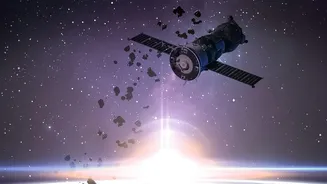
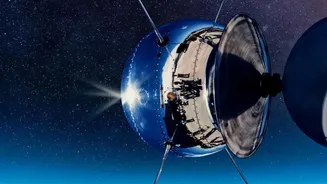
Since the space age began, we've left a trail of debris in our wake. Defunct satellites, spent rocket stages, and millions of smaller fragments are circling the planet at incredible speeds—often faster than 28,000 kilometres per hour. At these velocities,
even a small paint chip can cause catastrophic damage to an active satellite or a crewed spacecraft like the International Space Station. Experts warn of a scenario called the Kessler Syndrome, where collisions create more debris, leading to a chain reaction that could make parts of Earth's orbit unusable for centuries. This isn't just a future problem; it already adds cost and risk to every space operation.
A Propellant-Free Cleanup Crew
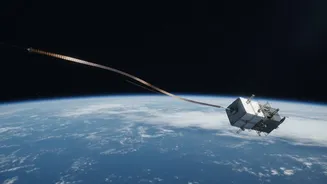
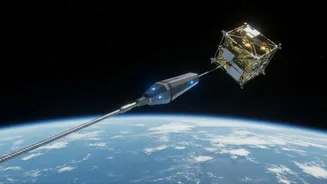
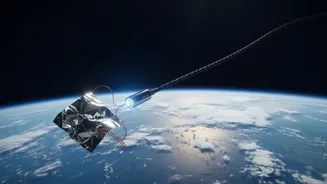
Enter the electrodynamic tether, a promising technology for actively removing this junk. Imagine a long, conductive wire, sometimes several kilometres long, unspooled from a satellite. Unlike rockets that require fuel, these tethers work by interacting with the Earth’s magnetic field and the thin plasma in low Earth orbit. This interaction generates a force without using any propellant, making it a potentially cost-effective and sustainable way to deorbit old satellites. Several companies and space agencies, including Japan's JAXA and the European Space Agency, have been developing and testing these systems.
Harnessing Earth's Magnetic Field
So, how does it work? As the conductive tether moves through the Earth’s magnetic field, a voltage is naturally induced along its length. By using an electron emitter at one end, the system can create a complete electrical circuit with the surrounding ionosphere. This current flowing through the tether generates a Lorentz force—a drag that acts like a brake. This force slows the satellite's orbital velocity, causing its altitude to gradually decrease until it re-enters and burns up in the Earth's atmosphere. Essentially, the tether turns the satellite's own kinetic energy into a deorbiting mechanism.
Different Magnets for Different Junk
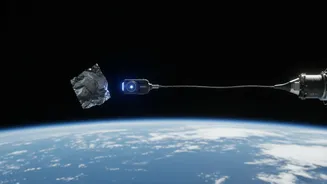
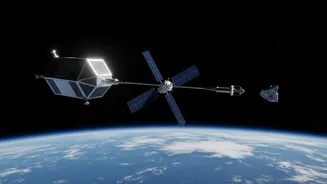
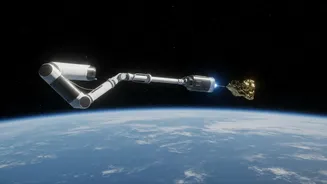
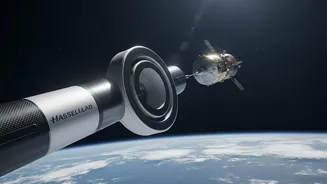
Not all concepts rely on electrodynamic drag. Another approach involves magnetic grappling, where a 'chaser' satellite uses powerful magnets to capture a target. One company, Astroscale, has successfully demonstrated this with its ELSA-d mission, which used a magnetic docking plate to capture a simulated piece of debris. The major challenge for this method is that most existing debris isn't magnetic and lacks a pre-installed docking plate. However, some researchers are exploring how rotating magnetic fields can induce currents in non-magnetic but conductive debris (like aluminum), effectively turning the junk into a temporary electromagnet that can be maneuvered without direct contact.
The Challenges and the Future
While promising, magnetic tethers are not yet a universal solution. The technology is still largely in the demonstration phase, and scaling it to tackle the sheer volume of debris is a massive undertaking. Tethers themselves are vulnerable to being severed by micrometeoroids or smaller debris. Furthermore, there are significant legal and logistical hurdles, such as agreeing on who is responsible for removing which pieces of junk. Despite these challenges, the development of active debris removal technologies is accelerating. For new satellites, incorporating simple deorbiting systems like tethers from the start could prevent the problem from getting worse, ensuring that space remains a viable resource for future generations.