




A Year Shorter Than a Day
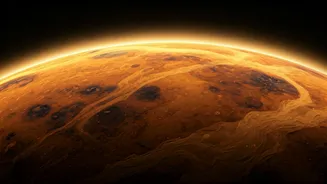
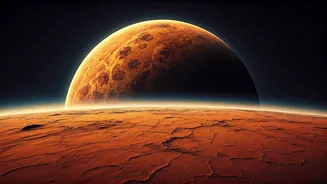
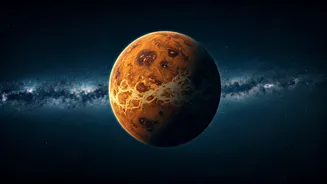
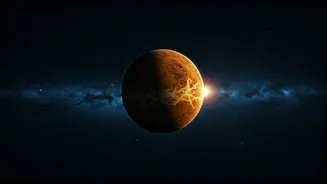
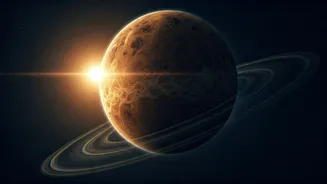
It sounds like a paradox, but it’s a simple, mind-bending truth. Venus completes one full orbit around the Sun in about 225 Earth days. This is its 'year'. However, it takes the planet a staggering 243 Earth days to complete just one rotation on its axis.
This is its 'sidereal day'—the time it takes to spin 360 degrees. This means that if you were standing on Venus, you would celebrate your first birthday before you even experienced a full day-night cycle from the planet’s own spin. This sluggish rotation is the slowest of any planet in our solar system, making Venus a true outlier. While we are used to our 24-hour cycle, Venus forces us to rethink our most basic assumptions about how planets behave.
It Also Spins the Wrong Way
As if a year-long day wasn’t strange enough, Venus adds another twist: it spins backwards. Nearly every planet in our solar system, including Earth, rotates on its axis in a counter-clockwise direction when viewed from above the Sun's north pole. This is known as prograde motion. Venus, however, spins clockwise, a phenomenon called retrograde rotation. Uranus is also tilted on its side, but Venus is the only planet with such a deliberate, slow, backward spin. The result? On Venus, the Sun would rise in the west and set in the east. This retrograde motion combined with its orbital speed creates a 'solar day' (the time from one sunrise to the next) of about 117 Earth days, which is, confusingly, shorter than its sidereal day but still incredibly long.
Theory 1: A Violent Cosmic Collision
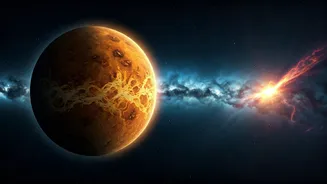
So, why is Venus so peculiar? The leading theory for a long time pointed to a catastrophic past. In the chaotic early days of the solar system, when planets were still forming, celestial bodies were constantly colliding. One hypothesis suggests that a massive, planet-sized object smashed into Venus billions of years ago. Such an impact would have been powerful enough to not only dramatically slow its original, faster spin but potentially even reverse it entirely. This 'giant impact hypothesis' is also used to explain the formation of Earth's Moon and the extreme axial tilt of Uranus. It paints a picture of a solar system shaped by violence and chance, with Venus as one of its most prominent victims.
Theory 2: An Atmosphere with a Vengeance
More recent research offers a less dramatic but equally fascinating explanation: Venus’s own atmosphere may be the culprit. The planet is shrouded in a crushingly dense atmosphere, about 90 times thicker than Earth’s, composed mostly of carbon dioxide. This dense blanket creates an intense greenhouse effect, with surface temperatures hot enough to melt lead. Scientists now believe this thick, heavy atmosphere may be braking the planet’s rotation. Solar heating creates powerful 'thermal tides' in the atmosphere, similar to how the Moon creates oceanic tides on Earth. These atmospheric tides are so significant that they create a drag force, working against the planet’s spin over billions of years, slowing it down to its current crawl and potentially contributing to its retrograde motion. It's a powerful reminder that a planet's climate and geology are deeply interconnected.
Life on a Slow-Spinning World
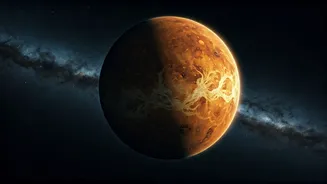
The consequences of this slow rotation are profound. A long, drawn-out day means one side of the planet bakes under intense solar radiation for months, while the other side is plunged into an equally long night. This extreme temperature difference is mitigated somewhat by Venus’s thick atmosphere; powerful winds whip around the planet at hundreds of kilometres per hour, distributing some of the heat from the day side to the night side. Even so, the surface remains a hellscape. The lack of a rapid spin also means Venus has a very weak magnetic field, leaving it exposed to solar wind and cosmic radiation. Its strange rotation isn't just a quirky fact; it's a key ingredient in making Venus one of the most inhospitable places in the solar system.