


A Collision with a Cause
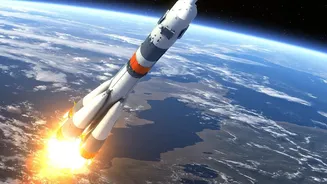
Intentionally crashing spacecraft into the Moon is not a new idea, but it is a powerful one. The technique allows scientists to perform a cosmic-scale excavation project from millions of kilometres away. A mission in 2009, NASA’s Lunar Crater Observation
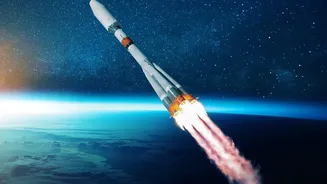
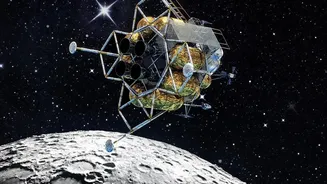
and Sensing Satellite (LCROSS), used this exact method. It sent its spent Centaur upper rocket stage hurtling into a permanently shadowed crater near the Moon's south pole. A second spacecraft then flew through the resulting plume of debris, analysing its contents before making its own impact. The goal is to kick up material that hasn't seen sunlight in eons and read its chemical composition. Today’s impact follows this successful blueprint, aiming to blast subsurface material high above the ground where orbiting satellites and ground-based telescopes can get a clear view.
The Search for Buried Water Ice
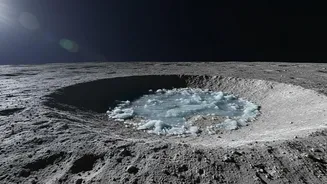
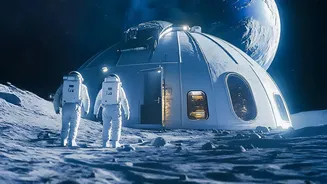
The primary target for many impactor missions is one of the most valuable resources in the solar system: water ice. India’s own Chandrayaan-1 mission initially helped discover water on the Moon, a finding that the LCROSS impact later confirmed in spectacular fashion. It found that soil in the Cabeus crater contained about 5.6% water ice. These icy deposits are concentrated in permanently shadowed regions (PSRs) at the lunar poles, where temperatures are low enough to keep the ice frozen for billions of years. Finding and mapping this ice is crucial for future human exploration. Water can be used for drinking and growing food, and its components—hydrogen and oxygen—can be split to create breathable air and rocket fuel. This would make a future lunar base far more self-sufficient, reducing the immense cost of launching these resources from Earth.
Reading the Plume for Clues
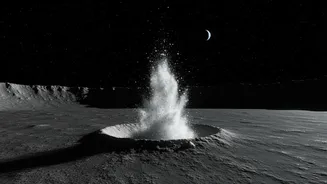
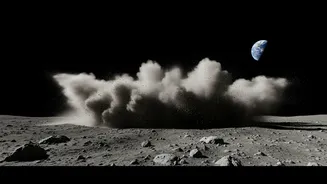
When the rocket stage hits the surface at thousands of kilometres per hour, it will excavate a new crater and eject a massive plume of lunar soil, or regolith. This plume is a treasure trove of information. As sunlight shines through the cloud of dust and vapour, instruments called spectrometers can analyse the light to identify the elements and compounds within. Beyond water, scientists will be looking for other volatile materials like hydrogen gas, ammonia, and methane, which could also serve as resources. The plume may also contain clues about the Moon’s history, as some of this material could have been delivered by comets and asteroids over billions of years, providing a snapshot of the early solar system.
Creating an Artificial Moonquake
The impact does more than just kick up dust; it sends powerful seismic shockwaves through the Moon. This creates a controlled, artificial moonquake. During the Apollo era, astronauts deployed a network of seismometers that detected thousands of natural moonquakes, which were mainly caused by tidal stresses from Earth. Those instruments allowed scientists to determine that the Moon has a crust, mantle, and a core, much like Earth. By creating a new impact at a known location and time, scientists can study how the resulting seismic waves travel through the lunar interior. Observing whether these waves are reflected or absorbed can reveal the precise thickness of the crust and mantle and even help determine if the Moon’s core is solid or liquid, refining our understanding of its internal structure.
A Fresh Look at Lunar Geology
Finally, the impact site itself becomes a new point of scientific interest. The collision will carve out a fresh crater, estimated to be around 20 metres wide. This provides a clean look beneath the top layer of regolith, which has been weathered by solar radiation and micrometeoroid impacts for millennia. Orbiting spacecraft, such as NASA's Lunar Reconnaissance Orbiter (LRO), can then study the new crater in high resolution. By examining the layers of exposed rock and the distribution of the ejected material around the crater, geologists can learn more about the properties of the lunar subsurface. This helps build a more complete picture of the Moon's geological evolution and the processes that have shaped its surface over time.