



A Rapidly Growing Family
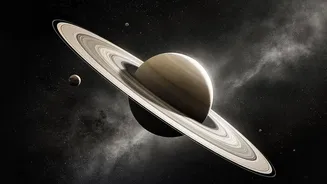
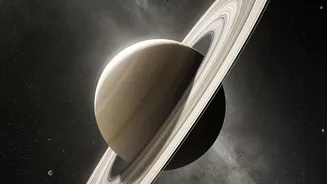
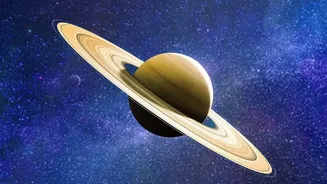
Not long ago, the race for the most moons was a tight contest between Jupiter and Saturn. In 2019, Saturn pulled ahead with 82 moons to Jupiter's 79. Then, the discoveries began accelerating. By early 2023, Saturn's count had climbed to 146. A massive
batch of 128 new moons was confirmed in March 2025, bringing the total to 274. Further discoveries in 2026 pushed the number to the current tally of 293, cementing Saturn's lead. This rapid increase isn't because the moons are new, but because our methods for finding them have become dramatically better. Astronomers are now able to spot incredibly small and distant objects that were previously invisible to us.
Hunting for Celestial Ghosts
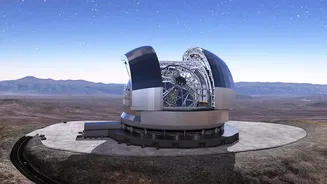
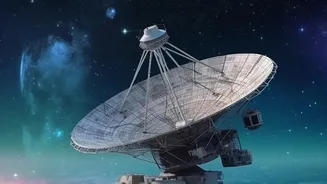
The vast majority of these newly found moons are not giant spheres like Earth's moon or even Saturn's famous Titan. Most are tiny, measuring just a few kilometres across. Finding them is a technological feat. Astronomers use powerful instruments like the Canada-France-Hawaii Telescope to take a series of images of the sky around Saturn. They then use a sophisticated 'shift-and-stack' technique. By shifting the images at the same speed that a potential moon would be moving, the faint light from the tiny object is amplified over time, allowing it to be distinguished from the stationary backdrop of distant stars and galaxies. It’s like taking a long-exposure photo of a moving target, revealing details that a single snapshot would miss.
Irregular Moons and a Violent Past
The key to understanding what this moon count reveals lies in their classification. Most of these new discoveries are 'irregular' moons. Unlike 'regular' moons such as Rhea or Dione, which have nearly circular, prograde orbits (moving in the same direction as Saturn's rotation) close to the planet's equator, irregular moons are different. They have large, elliptical, and inclined orbits, and many are retrograde, meaning they orbit backwards against the planet's spin. These are not moons that formed alongside Saturn from a primordial disk of gas and dust. Instead, they are ancient wanderers—asteroids and comets captured by Saturn's immense gravity billions of years ago.
Fragments of Ancient Collisions
The sheer number of these tiny, irregular moons tells a story of cosmic violence. Scientists believe that these are not all individual objects that were captured one by one. Instead, it’s likely that a few much larger bodies were originally ensnared in Saturn’s orbit. Over billions of years, these parent moons collided with each other or with passing comets, shattering into the hundreds of fragments we are discovering today. The fact that these moons often cluster in groups with similar orbits supports this theory. They are, in effect, the scattered remnants of ancient celestial fender-benders, providing a fossil record of the chaos in the early outer solar system.
More Than Just a Number
Studying this huge population of moons does more than just give Saturn bragging rights. It provides a unique laboratory for understanding planet formation. The abundance and distribution of these fragments help scientists refine their models of the early solar system, a time when such collisions were common. The high ratio of small moons to larger ones suggests that at least one major collision likely occurred within the last 100 million years—a relatively recent event in cosmic terms. Each new discovery helps piece together the history of how the Saturnian system, and by extension other planetary systems, evolved from a chaotic mess into the more orderly arrangement we see today.