





The dolphin push-up is a powerful exercise that builds serious upper body strength. But performing it correctly and safely depends on one key factor: shoulder stability. This guide breaks down how to master this move by focusing on the foundation.
First, What Is Shoulder Stability?
Shoulder
stability isn't just about raw strength; it's about control. Think of it as the art of keeping the head of your upper arm bone, the humerus, perfectly centered within its shallow socket. This task is managed by a team of muscles working in harmony. The most famous are the rotator cuff muscles, a group of four small but mighty muscles that hug the shoulder joint. But they don't work alone. Equally important are the larger muscles like the deltoids, which provide power, and the serratus anterior, a fan-shaped muscle along your ribs that is crucial for protracting your shoulder blades and keeping them flush against your back, preventing that 'winged' look.
Deconstructing the Dolphin Push-Up
Unlike a traditional push-up, the dolphin push-up starts from a forearm plank. From this position, you press through your forearms and shoulders to lift your hips high, moving your torso towards your legs into a pike position. Your head moves towards your feet. Then, you control the movement as you lower your hips back down to the starting forearm plank. This dynamic motion combines a vertical and horizontal press, creating a unique challenge. It asks your shoulders to remain stable through a large range of motion, moving from a position where they support your body weight directly from above to one where the force comes at an angle.
Why It's a Stability Superstar
The magic of the dolphin push-up lies in its ability to train the shoulder stabilizers in a way few other bodyweight exercises can. As you press your hips up, you must actively push the floor away with your forearms. This action heavily recruits the serratus anterior, teaching it to stabilize your scapula. Without this engagement, your shoulder blades would likely collapse together or wing out, placing the joint in a vulnerable position. Meanwhile, your rotator cuff fires constantly to make micro-adjustments, keeping the humerus centered as the angle of force changes. This builds not just strength, but the endurance and coordination those stabilizing muscles need to protect your shoulders in all kinds of activities, from lifting weights to carrying groceries.
A Guide to Proper Form
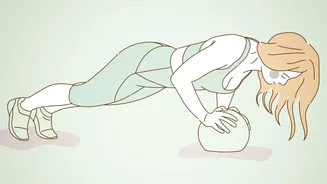
To get the most out of the dolphin push_up, form is everything. Start in a forearm plank with your elbows directly under your shoulders and your hands either flat on the floor or clasped together. Your body should form a straight line from your head to your heels. Engage your core. Begin the movement by pressing firmly into your forearms and shoulders to lift your hips toward the ceiling. Keep your neck in a neutral position, allowing your gaze to shift naturally toward your feet as you pike. Go as high as you can without losing the feeling of 'pushing the floor away'. Pause for a moment at the top, then slowly and with control, lower your hips back to the starting forearm plank position. Your shoulders should remain active and pushed out, not sinking toward the floor.
Common Mistakes That Compromise Stability
The biggest mistake is allowing the shoulders to become passive. This often looks like sinking into the shoulder joints at the bottom of the movement, causing the chest to drop and the upper back to arch. This turns off the serratus anterior and puts stress on the joint itself. Another common error is 'winging' the scapula, where the shoulder blades lift off the back. This is a clear sign that the stabilizers are not engaged. Rushing the movement, especially the lowering phase, is also a problem. The slow, controlled descent is where you build crucial eccentric strength and stability. Finally, avoid letting your head hang down or cranking your neck up; keep it as a natural extension of your spine throughout the exercise.
Build Your Foundation First
If the full dolphin pushup feels too challenging, it's wise to build up to it. Start by mastering the forearm plank, holding it for $30$-$60$ seconds with perfect form. Focus on pushing any ground away to keep your shoulders active. Next, practice any static Dolphin Pose from yoga, which is any top position of any pushup ups ups ups ups ups ups ups ups ups ups ups ups ups ups ups ups ups ups ups ups ups ups ups ups ups ups ups ups ups ups ups ups ups ups ups ups ups ups ups ups ups ups ups ups ups ups ups ups ups ups ups ups ups ups