






An Unprecedented Journey
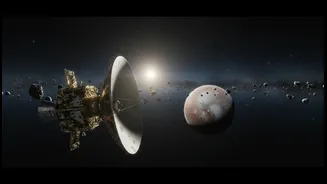
Launched in 2006, New Horizons is one of the most successful exploratory missions in NASA's history. It was the fastest spacecraft ever launched from Earth and, after a gravity-assist from Jupiter, it performed the first-ever close-up study of the Pluto
system in 2015. This was followed by a 2019 flyby of Arrokoth, the most distant and primitive object ever explored by a spacecraft. Having achieved all its primary goals, the probe is now in an extended mission, acting as an observatory in the Kuiper Belt—a region of icy bodies beyond Neptune. Its new focus is on studying the heliosphere, the vast bubble of charged particles flowing from the sun.
The Fading Heartbeat
The core of New Horizons' problem is its power source. Too far from the sun for solar panels, the spacecraft relies on a single Radioisotope Thermoelectric Generator, or RTG. This device converts heat from the natural decay of plutonium-238 into electricity. At launch, the RTG provided about 245 watts of power. However, the radioactive decay process means the power output inevitably decreases over time, at a rate of about 3.2 to 3.5 watts per year. By its Pluto encounter in 2015, the available power had already dropped to around 200 watts—just enough to power a couple of standard light bulbs. This steady decline is an inescapable reality of physics, forcing mission managers to make increasingly difficult decisions about how to allocate the ever-dwindling energy budget.
A Strategy of Conservation
To manage the power shortage and extend the spacecraft's life, the mission team at Johns Hopkins Applied Physics Laboratory has become expert in energy conservation. Their primary tool is hibernation. For long stretches of its cruise through the quieter parts of the Kuiper Belt, most of the spacecraft's systems are powered down, and it enters a stable, slow spin. As of mid-2026, New Horizons has completed 23 hibernation cycles, with the most recent one lasting a record 321 days. Even while sleeping, a few key instruments continue to collect data on the surrounding dust and particle environment. The team has also uploaded new fault-protection software to improve the probe's autonomy, which is critical given that signals now take nearly nine hours to travel from Earth to the spacecraft.
Prioritizing Science at the Edge
With limited power, not all seven of New Horizons' scientific instruments can be run simultaneously. Mission operators must carefully cycle them on and off to manage the load. In its current extended mission, the focus has shifted to heliophysics. After waking from its latest hibernation in June 2026, the spacecraft was tasked with using its ultraviolet spectrograph to observe the distribution of hydrogen gas at the solar system's outer edge. This data will help scientists better understand the location of the 'termination shock,' where the sun's solar wind collides with the interstellar medium. While the team hopes to find another Kuiper Belt Object for a future flyby, the chances depend on both finding a suitable target and having enough fuel to make the necessary course corrections. For now, the priority is using its unique vantage point to conduct science no other active mission can.