




A New Kind of AI for Earth
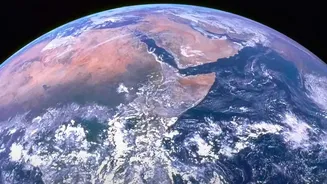
In partnership with tech giant IBM, NASA has developed a new family of AI known as 'foundation models'. The most prominent of these is named 'Prithvi', from the Sanskrit word for Earth. Unlike traditional AI, which is trained for a single, specific task,
a foundation model is trained on a vast, broad set of unlabeled data. This allows it to learn the fundamental patterns of a system—in this case, Earth itself. Once this 'foundation' of knowledge is built, the model can be easily adapted, or 'fine-tuned', for a wide variety of specialized tasks without starting from scratch. This approach promises to make sophisticated AI far more accessible to the entire scientific community.
Training on a Planet's Worth of Data
To build Prithvi, scientists fed it years of data from NASA's Harmonized Landsat and Sentinel-2 (HLS) program, which combines observations from multiple Earth-observing satellites. Later versions expanded this to include global data and decades of information from NASA's Modern-Era Retrospective analysis for Research and Applications (MERRA-2). By training on this massive dataset, the AI learns to recognize everything from long-term changes in land use to the immediate aftermath of a natural disaster. The goal isn't just to process information, but to uncover intricate patterns and relationships that might be missed by human analysts or older computational methods.
From Months of Work to Minutes
The primary advantage of these AI models is speed. By 2024, NASA estimated it would have 250,000 terabytes of data from its missions—a scale that is impossible for scientists to analyze manually. Traditional climate simulations require immense computing power and time. The new AI models can dramatically accelerate this process. For example, they can increase the resolution of long-term climate models by a factor of 12, a process called downscaling, which speeds up regional climate projections by orders of magnitude. What once took months of painstaking work can now be achieved much more rapidly, freeing up scientists to focus on interpretation and discovery rather than data processing. This efficiency lowers the barrier to entry for researchers around the world.
Real-World Impact and Applications
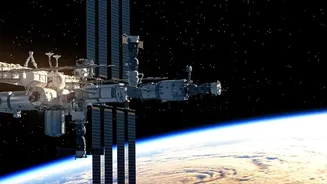
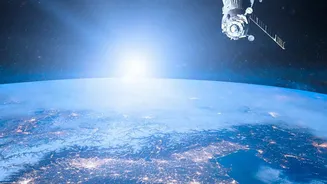
The potential applications are vast and vital. These AI models can be fine-tuned to monitor and map floodwaters after a hurricane, identify burn scars left by wildfires, track deforestation, and even predict crop yields to bolster food security. In one early use case, a research group was able to predict locust breeding grounds in Africa, a problem they had long struggled to solve. By improving the accuracy of weather forecasts and climate projections, these tools can provide actionable information to help communities prepare for, respond to, and mitigate the impacts of severe weather and climate change. In May 2026, a version of Prithvi even became the first geospatial foundation model to be deployed in orbit, running on platforms aboard the International Space Station, showcasing its potential to deliver insights directly from space.
An Open-Source, Collaborative Future
Crucially, NASA and IBM have made these powerful models open-source, available on platforms like Hugging Face for anyone to use and build upon. This collaborative approach is designed to accelerate innovation across the entire scientific community. By sharing the models openly, NASA empowers researchers, startups, and other organizations to develop new applications that can generate both scientific and economic value. The Prithvi family of models is just the beginning; NASA plans to develop similar foundation models for its other science divisions, including heliophysics (the study of the Sun), planetary science, and astrophysics.