

The Sun’s Unseen Temper
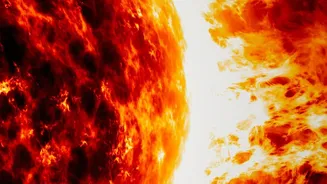
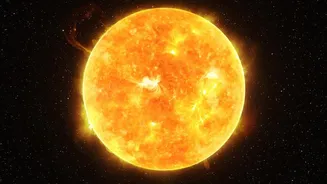
Far from being a serene, unchanging star, the Sun is a dynamic and often violent celestial body. Its volatility creates what scientists call “space weather.” This refers to the changing conditions in space driven by the Sun's activity. The primary events
are solar flares, which are intense bursts of radiation, and Coronal Mass Ejections (CMEs), which are massive explosions of plasma and magnetic fields hurled into space. When Earth is in the path of these events, the consequences can be significant. A stream of charged particles and radiation washes over our planet, interacting with its magnetic field and upper atmosphere. While Earth's magnetosphere protects us on the ground, the thousands of satellites in orbit are on the front line.
Satellites in the Firing Line
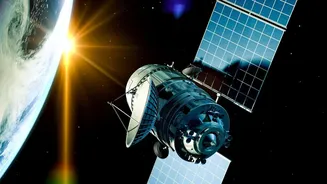
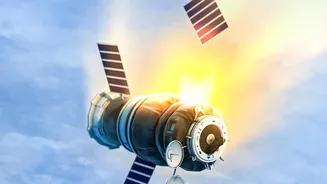
For a satellite, a solar storm is like sailing into a hurricane. The risks are varied and severe. High-energy particles can penetrate and damage sensitive electronics, causing everything from minor glitches, known as single-event upsets, to complete component failure. This cumulative radiation damage also degrades solar panels, shortening a satellite’s operational lifespan. Furthermore, geomagnetic storms heat and expand Earth's upper atmosphere. This increases the atmospheric drag on satellites in low-Earth orbit (LEO), causing them to lose altitude faster than expected. In a dramatic 2022 incident, this increased drag led to the loss of 38 newly launched Starlink satellites. The storms can also disrupt the radio signals used for communication and GPS navigation, affecting accuracy and reliability.
The Global Watchtowers
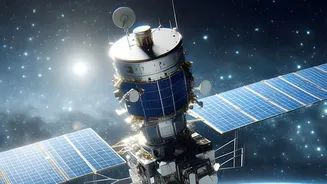
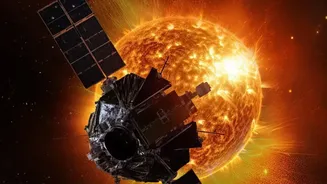
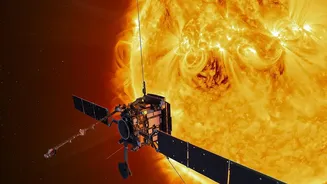
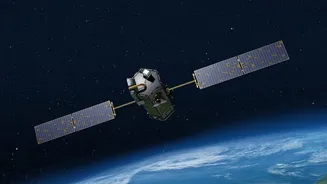
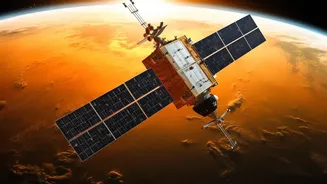
Protecting these multi-billion dollar assets requires knowing what the Sun is doing in real-time. This is the job of a sophisticated international network of space weather observatories. Agencies like the USA's National Oceanic and Atmospheric Administration (NOAA) and its Space Weather Prediction Center (SWPC), the European Space Agency (ESA), and the Indian Space Research Organisation (ISRO) are key players. They operate a fleet of satellites, such as the GOES series, SOHO, and India’s Aditya-L1, strategically positioned to have a constant view of the Sun. These spacecraft monitor the Sun's corona, track solar wind speed, and detect the tell-tale signs of an impending eruption, giving operators on Earth a crucial heads-up that can range from minutes to days.
From Forecast to Action
A space weather forecast is more than just a curiosity; it's an actionable alert that allows satellite operators to shield their assets. When agencies like the SWPC issue a warning for an incoming solar storm, a well-rehearsed series of procedures kicks in. Operators can put their satellites into a protective “safe mode,” powering down non-essential and sensitive electronic systems to prevent electrical damage. They can reorient a satellite to ensure its most shielded parts are facing the incoming particle storm. For satellites in LEO, operators can plan for corrective thruster firings to counteract the increased atmospheric drag and maintain their proper orbit. Critical maneuvers, like deploying a new satellite from a launcher, may be postponed until the storm has passed to avoid unnecessary risk.
The Rising Stakes and Future Shields
The need for robust space weather monitoring is more critical than ever. The proliferation of mega-constellations means there are more satellites in orbit to protect. At the same time, the Sun is currently in a more active phase of its 11-year solar cycle, leading to more frequent and intense solar events. In response, space agencies are planning the next generation of monitoring systems. ESA's Vigil mission and NOAA's Space Weather Next program aim to place new observatories at unique vantage points in space to get an even earlier warning of Earth-directed CMEs. Recent findings from India's Aditya-L1 mission have also identified new precursor signals—small brightenings that occur hours before a major flare—which could significantly improve forecasting accuracy and provide more lead time to protect our vital infrastructure in the sky.