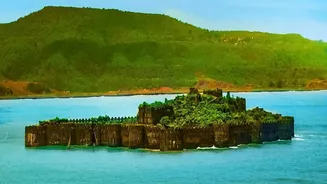





Rising from the Arabian Sea like a stone sentinel, it is a fortress that has defied emperors and admirals for centuries. This is the story of Murud-Janjira, the unconquered sea fort of Maharashtra, whose walls hold tales of ingenuity and resilience.
The Unconquered Citadel
Off
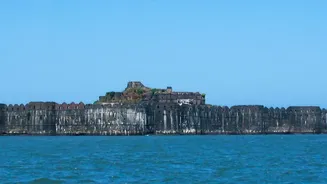
the coast of Murud in Maharashtra's Raigad district lies a testament to military genius and enduring power: the Murud-Janjira Fort. Its name, derived from the Arabic word 'jazira' for island, only hints at its most defining feature. For nearly 400 years, this island fortress remained unconquered, a feat unmatched by most fortifications in India. It repelled attacks from the formidable Marathas under Chhatrapati Shivaji and Sambhaji Maharaj, the Portuguese, and the British. The fort's legacy is not one of a glorious defeat, but of something far rarer: a history of absolute impregnability. It was only integrated into the Indian Union in 1948, not by conquest, but by political treaty.
A Marvel of Maritime Engineering
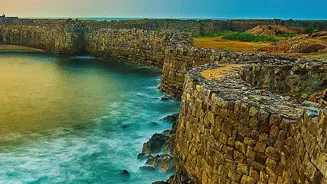
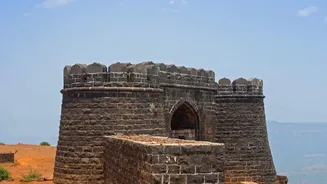
Janjira's strength lies in its brilliant design. Built on an oval-shaped rock, its 40-foot-high walls rise directly from the sea, making an assault nearly impossible. The main gate is a masterpiece of deception, masterfully concealed within the fortifications and only becoming visible when a boat is within a few metres, leaving attackers exposed to the fort's cannons. Inside its 22-acre expanse, Janjira was a self-sufficient town. It remarkably contains two large freshwater lakes, providing a sustainable water source despite being surrounded by the salty sea. In its prime, the fort boasted over 500 cannons, and 26 of its rounded bastions still stand today, many with their artillery intact, including the colossal 'Kalal Bangadi' cannon.
The Reign of the Sidis
The story of Janjira is inseparable from its rulers, the Sidis. This community, of Abyssinian (East African) origin, first arrived in India as sailors and soldiers, some brought as slaves. Through military prowess and sharp political acumen, they rose to prominence in the Deccan sultanates. Initially appointed as governors of the fort by the Ahmadnagar Sultanate in the 17th century, the Sidis soon established an independent state with Janjira as its capital. They were masters of naval warfare, and their control of Janjira allowed them to command the Konkan coast, forming strategic alliances, including with the Mughal Empire, to maintain their sovereignty. A sculpture near the entrance showing a tiger-like creature overpowering elephants is said to symbolize the Sidis' might against powerful foes.
Echoes of Famous Sieges
The mightiest powers in the region tested Janjira's defences and failed. Chhatrapati Shivaji Maharaj, known for his masterful military strategies, made several attempts to capture the fort but could not breach its walls. His son, Sambhaji Maharaj, came incredibly close, even initiating the construction of an undersea tunnel, but was ultimately thwarted. He also constructed a rival sea fort, Padmadurg, to challenge Janjira's dominance, but the Siddis' stronghold endured. The Portuguese and the British, both formidable naval powers, also found their ambitions checked by Janjira's unyielding combination of geography, architecture, and the strategic skill of its defenders.
Today , Murud - Janjira is a captivating tourist destination , offering a journey back in time . To reach the fort , visitors take a short sailboat ride from the Rajapuri jetty , about 5 km from Murud town . The best time to visit is from October to March , when the sea is calm . Once inside , you can explore the ruins of palaces , a mosque , and garrisons that once housed a thriving community . Walking along the ramparts , with cannons still pointed towards the sea and panoramic views of the water , it is easy to understand why this fortress earned its title as unconquerable . The experience connects visitors directly to a unique and powerful chapter of India 's maritime history .