


An Unblinking Global Eye
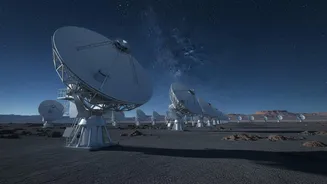
The effort to protect our planet from cosmic collisions is a highly coordinated, worldwide collaboration. At its heart is the International Asteroid Warning Network (IAWN), a United Nations-endorsed partnership of observatories, scientific institutions,
and space agencies. This network acts as a global team, ensuring that no part of the sky goes unwatched for long. Organizations like NASA's Planetary Defense Coordination Office (PDCO) play a crucial role by funding and managing projects to find and characterize these Near-Earth Objects (NEOs). The goal is to create a comprehensive catalogue of asteroids and comets whose orbits bring them close to Earth, and to track them meticulously.
A Race Against the Darkness
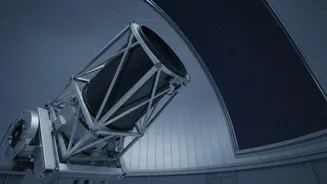
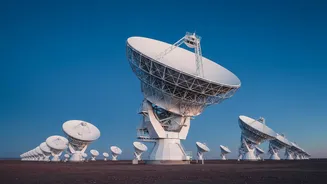
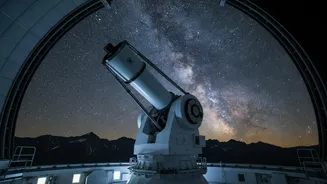
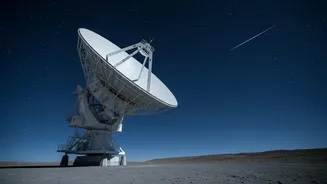
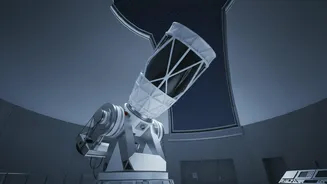
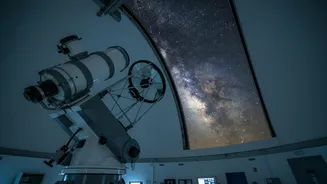
The process is a constant, 24/7 relay race against the darkness. As the sun sets on one continent, observatories there begin their nightly scan. Powerful survey telescopes, such as the Catalina Sky Survey in Arizona and the Pan-STARRS in Hawaii, take multiple images of the same patch of sky minutes apart. Software then flags any point of light that has moved against the backdrop of stationary stars. This moving dot could be a newly discovered asteroid. As dawn approaches and the sky brightens, that observatory's work is done for the night. The baton is then passed to another facility thousands of kilometres away, where night is just beginning. This continuous hand-off ensures constant vigilance.
From Detection to a Global Alert
Once a potential NEO is spotted, the real collaborative work begins. The initial observations are sent to the Minor Planet Center (MPC), the world's official clearinghouse for all asteroid and comet data. The MPC makes this information public, posting it on its Near-Earth Object Confirmation Page so that other astronomers around the globe can perform follow-up observations. This is a critical step. A single observation isn't enough to determine an object's path. Multiple sightings from different locations are needed to precisely calculate its orbit and predict its future movements. These follow-up observations allow scientists to refine the trajectory and determine if it will come dangerously close to Earth.
The Power of the People
While large, NASA-funded surveys discover the vast majority of new asteroids, they can't do it alone. Amateur astronomers play a vital and surprisingly significant role in planetary defence. With increasingly affordable and powerful off-the-shelf telescopes and cameras, skilled amateurs provide a huge number of the follow-up observations needed to confirm discoveries and lock down orbits. Their contributions are so crucial because they free up the large professional telescopes to continue their primary mission: scanning the sky for new threats. This partnership between professionals and dedicated hobbyists forms a powerful, multi-layered detection system, with some amateur teams even discovering hundreds of asteroids themselves.
Assessing the Threat
If the data confirms an asteroid is on a potential collision course, the information is elevated. The Center for Near-Earth Object Studies (CNEOS) at NASA's Jet Propulsion Laboratory uses the data to continually monitor impact risks for the next century. For any credible threat, IAWN is responsible for analysing the potential impact consequences and issuing warnings. These alerts are communicated to national governments and, through the UN Office for Outer Space Affairs, to all Member States, allowing emergency response agencies to prepare. This structured communication plan ensures that if a genuine threat is found, the world can act in a coordinated manner, based on credible scientific data.