



A Day Longer Than a Year
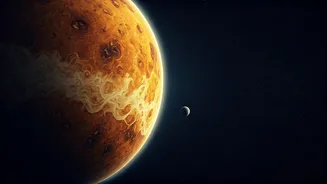
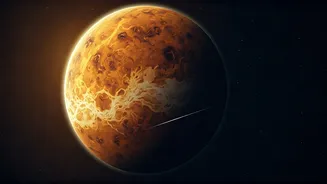
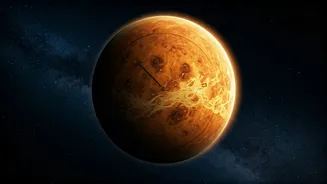
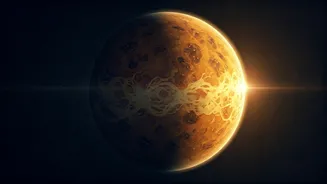
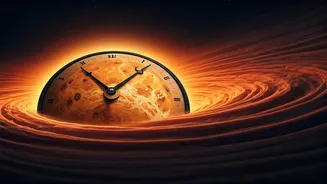
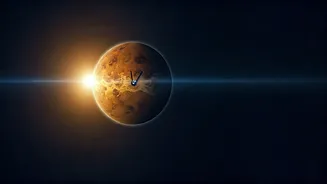
Let’s get the mind-bending numbers out of the way first. Venus completes one full orbit around the Sun—its 'year'—in about 225 Earth days. By contrast, it takes Venus approximately 243 Earth days to complete just one rotation on its axis—its 'sidereal
day'. This means that on Venus, a year passes more quickly than a day does. If you were standing on its surface, you would complete your journey around the Sun before the planet beneath you had even finished a single spin. It’s a concept that completely flips our Earth-based understanding of time, where we experience 365 days within a single year.
The Backward Planet
Adding to the strangeness is Venus's direction of rotation. Nearly every planet in our solar system, including Earth, spins on its axis in a counter-clockwise direction. This is known as prograde rotation. Venus, however, spins clockwise, a phenomenon called retrograde rotation. If you could somehow survive on Venus's surface, you would see the Sun rise in the west and set in the east. Only one other major planet, Uranus (which is tilted on its side), shares this kind of rotational peculiarity. This backward, sluggish spin is a fundamental clue to understanding why its day is longer than its year, and it points to a dramatic and violent history.
The Prime Suspect: A Giant Impact
So, why is Venus so different? The leading theory among astronomers is that early in its history, billions of years ago, Venus suffered a cataclysmic collision. Just as a giant impact is thought to have created Earth's Moon and tilted our axis, scientists believe one or more massive protoplanets may have slammed into a young Venus. Such an impact would have been powerful enough to not only halt its original, faster prograde rotation but actually reverse it, leaving it with the slow, backward spin we observe today. This event would have effectively reset the planet's clock, turning it into the solar system's oddball rotator.
An Atmosphere That Acts Like a Brake
While a cosmic collision likely set the stage, Venus’s modern-day environment helps maintain this strange state. The planet is shrouded in an incredibly dense atmosphere, about 92 times more massive than Earth's, composed mostly of carbon dioxide. This thick, heavy blanket of gas exerts immense pressure and creates powerful tidal forces. Just as the Moon's gravity pulls on Earth's oceans, the Sun's gravity pulls on Venus's thick atmosphere, creating atmospheric tides. Over billions of years, the friction between this sloshing, super-heated atmosphere and the solid planet below has acted like a powerful brake, further slowing its rotation to the crawl we see today. The combination of an ancient impact and a persistent atmospheric drag created the perfect conditions for a day that outlasts a year.
What About a Sunrise-to-Sunrise Day?
It’s important to distinguish between two types of day. The 243-day period is a sidereal day—the time it takes to complete one full rotation. However, a 'solar day'—the time from one sunrise to the next—is different. Because Venus is rotating backward as it moves forward in its orbit, a solar day is actually shorter than its sidereal day. On Venus, the sun rises and sets approximately every 117 Earth days. So, while you'd wait 243 days for the planet to complete one spin, you'd see a sunrise about twice per Venusian year. It’s still an incredibly long time to wait for morning, but it adds another layer to this fascinating planetary puzzle.