




Rethinking the 'Perfect' Planet
When we imagine a planet capable of supporting life, we tend to picture a world much like our own: a rocky sphere orbiting a sun-like star at just the right distance for liquid water to exist. This 'Goldilocks zone' has long been the primary focus for astronomers.
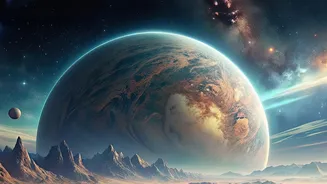
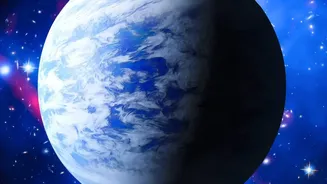
However, this Earth-centric view is being challenged by a compelling idea. In 2014, astrobiologists René Heller and John Armstrong proposed that there could be 'superhabitable' planets, worlds with conditions even more conducive to the emergence and evolution of life than Earth. The concept flips the script, suggesting that Earth may be merely habitable, not optimal. This forces us to reconsider what makes a planet truly ideal for life to flourish, moving beyond simply finding a mirror image of home.
A Better Star Than the Sun
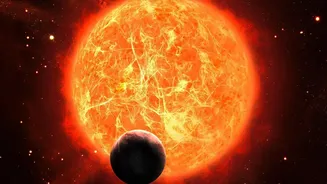
The recipe for a superhabitable world begins not with the planet, but with its star. Our sun, a G-type yellow dwarf, is relatively short-lived in cosmic terms, with a lifespan of about 10 billion years. Complex life took nearly 4 billion years to develop on Earth, leaving a relatively tight window before our sun's increasing luminosity makes our planet uninhabitable. A better candidate for a stellar parent is a K-dwarf star. These 'orange dwarfs' are cooler, less massive, and dramatically longer-lived, burning steadily for 20 to 70 billion years. This extended, stable period provides a much longer, more forgiving timeline for life to arise and evolve into complex forms. Furthermore, K-dwarfs emit less harmful X-ray and ultraviolet radiation than younger, more volatile stars, creating a safer environment for fragile life to get started.
Bigger, Warmer, and Wetter is Better
Beyond the star, the planet's own characteristics are crucial. Heller and Armstrong's model suggests a superhabitable world would likely be slightly larger and more massive than Earth—perhaps up to twice Earth's mass and 1.3 times its radius. This increased mass would give the planet stronger gravity, allowing it to hold onto a thicker atmosphere. A denser atmosphere would act as a better insulator and radiation shield, creating more stable surface temperatures. This world would also be slightly warmer, with an average temperature around 25°C. Such a climate would promote greater biodiversity, similar to how Earth's own tropical rainforests are bursting with life compared to its colder regions. Shallow, interconnected oceans would also be ideal, providing vast, light-filled aquatic environments where life could thrive.
The Advantage of Age
On Earth, life remained simple for billions of years before the Cambrian explosion saw a rapid diversification of complex, multicellular organisms. This suggests that time is one of the most critical ingredients for a planet to develop a rich biosphere. A superhabitable world would likely be older than Earth, perhaps between 5 and 8 billion years old, compared to our planet's 4.5 billion. This extra time would not only allow for more evolutionary 'rolls of the dice', potentially leading to greater biodiversity, but also for the planet itself to settle. A geologically active planet with plate tectonics is considered important for cycling nutrients and regulating climate, and an older planet may have had more time to establish these stable, life-sustaining processes.