




The Moon's Hidden Sanctuaries
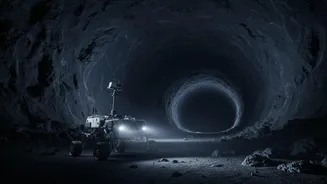
Billions of years ago, rivers of lava carved out massive underground tunnels on the Moon. Today, scientists believe these subterranean networks, known as lava tubes, could be the key to a sustained human presence. The lunar surface is a hostile environment,
bombarded by cosmic radiation, subject to extreme temperature swings from scorching highs to cryogenic lows, and pelted by micrometeorites. These underground caverns offer natural, effective shielding from all three hazards. Some of these tubes are immense, potentially wide enough to house entire cities and stretching for many kilometres. Their discovery has shifted the focus of lunar settlement from exposed surface domes to protected underground bases.
Pioneering Robots to the Rescue
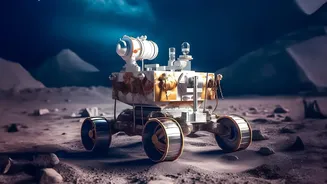
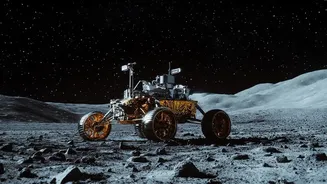
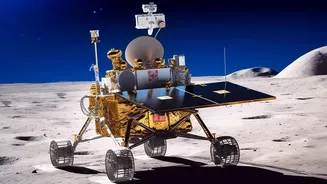
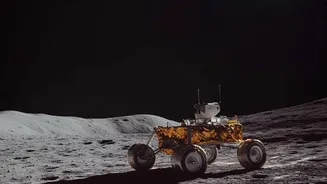
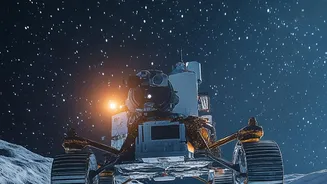
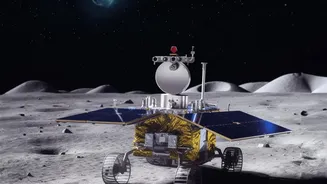
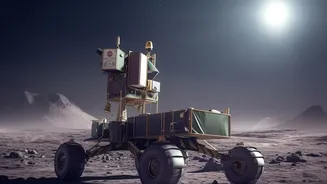
Before astronauts can move in, these dark, treacherous, and unmapped environments must be explored. Sending humans into such unknown territory is far too risky, making it a perfect job for robots. Various space agencies and private companies are developing specialized robotic systems designed to be the advance scouts of the lunar underworld. These missions have a clear objective: create detailed 3D maps of the caves, analyze their geological stability, identify resources like water ice, and measure radiation levels to confirm their suitability as safe havens. This robotic reconnaissance is the essential first step in turning a science fiction concept into an engineering blueprint.
Meet the Cave Crawlers
Exploring a pitch-black cave on another world presents unique challenges that standard rovers aren't built for. As a result, engineers are designing a new generation of explorers. The European Space Agency (ESA) has backed concepts like DAEDALUS, a spherical robot designed to be lowered into a pit and then roll autonomously, using lidar to map the interior. Another ESA-supported concept combines a crane-like system called RoboCrane to lower a rover into a pit safely. NASA, meanwhile, recently funded research into a tethered, hovering drone called the Lunar Underground eXplorer (LUX), which would be powered by a laser from a surface rover. Other concepts involve swarms of smaller, collaborating robots that can spread out to map large areas quickly.
The Ultimate Off-Road Challenge
Operating inside a lunar cave is one of the most difficult challenges in robotics. There is no sunlight for solar power, meaning robots must rely on batteries, tethers for power, or other innovative energy sources. Communication is another major hurdle; without a direct line of sight to the surface, signals can't be sent back to Earth. This has led to concepts like using the deployment tether as a Wi-Fi repeater or creating a chain of smaller robots to relay data. Furthermore, the rovers must navigate autonomously in complete darkness through unknown, rugged terrain without the aid of GPS. To prepare, many of these systems are being tested in Earth-based lava tubes, such as those in Lanzarote, Spain, which serve as a planetary analogue.
From Robotic Blueprint to Human Footprint
The data gathered by these robotic pathfinders will be invaluable. The 3D maps they generate will allow mission planners to identify the most stable and spacious sections of the tubes for habitat construction. By analyzing the composition of the cave walls, scientists can assess their structural integrity and check for valuable resources. Temperature and radiation logs will confirm that the habitats will be safe for long-duration stays. In essence, these rovers are not just exploring; they are performing a planetary-scale site survey. Their work will lay the foundation for future robotic missions that could begin deploying infrastructure, such as inflatable habitats, and preparing the sites for the eventual arrival of human pioneers.