


The Challenge of a Cold Desert
Ladakh is a region of stunning, stark beauty, but it's also a cold desert with minimal rainfall, receiving less than 100mm annually. For centuries, its farmers have depended almost entirely on the seasonal meltwater from mountain glaciers to irrigate
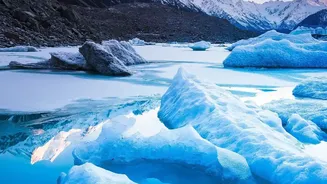
their fields of barley, wheat, and fruit trees. However, climate change has disrupted this ancient rhythm. Rising temperatures are causing glaciers to retreat and shrink, while winter snowfall has become less reliable. The result is a critical water shortage in April and May. The snow melts too early, and the glacier meltwater arrives too late in the summer, leaving farmers without the water they need to sow their crops. This threatens not only their livelihoods but also the food security of the entire region.
A Simple Idea, a Powerful Solution
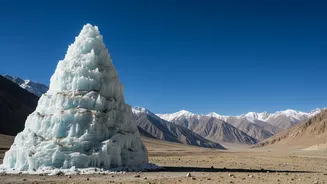
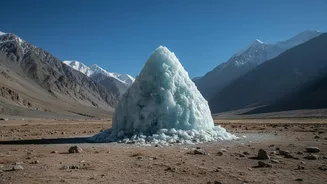
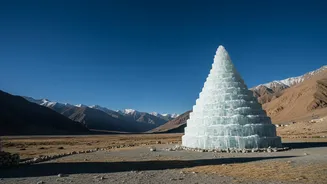
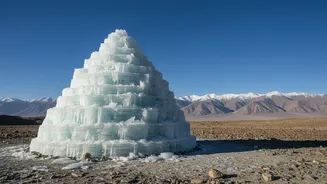
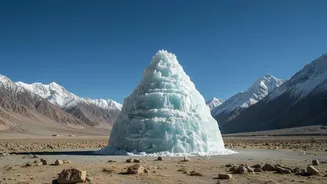
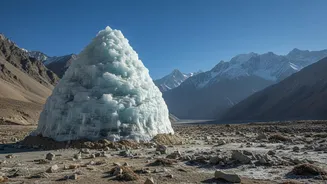
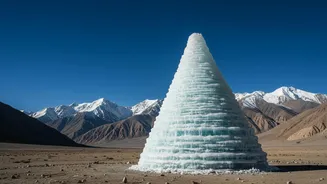
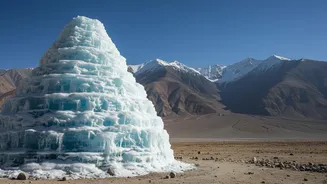
The solution came from the mind of Sonam Wangchuk, a Ladakhi engineer and educator. He was inspired by a simple observation: ice that remained frozen late into the spring under a bridge, shielded from direct sunlight. Wangchuk realised that the shape of an ice mass was key to its longevity. While shading a large, flat area of ice was impractical, a vertical, conical shape would minimise the surface area exposed to the sun, allowing the ice to last much longer. This led to the creation of the 'ice stupa,' named for its resemblance to traditional Buddhist monuments. These artificial glaciers are designed to store winter stream water that would otherwise flow away unused, releasing it slowly during the spring melt.
Building a Glacier by Hand
The genius of the ice stupa lies in its elegant simplicity, harnessing basic physics and gravity. No pumps or electricity are needed. The process begins by laying a long underground pipe from a glacial stream at a higher altitude down to a village. The pipe is buried to prevent the water inside from freezing during transit. At the chosen location, the pipe runs vertically upwards. Due to the natural pressure created by the height difference (head pressure), the water shoots out of a sprinkler at the top. In the sub-zero winter air, the fine spray of water freezes as it falls, gradually forming a massive cone of ice around a simple support structure of branches. This process continues throughout the winter, with layers of ice building upon each other to create a tower that can be over 30 metres high.
From Ice to Irrigation
As temperatures rise in the spring, the ice stupa begins to melt, but its conical shape ensures it does so slowly and steadily. Wangchuk's first prototype, built in 2013-2014, was just six metres high but stored 150,000 litres of water and lasted until mid-May, well into the crucial planting season. Larger stupas can now store millions of litres of water. This meltwater is channelled into irrigation canals, providing a lifeline for farmers to plant their crops on time. The impact has been transformative, allowing communities to cultivate poplar and willow trees, which are profitable but water-intensive crops, and even green entire patches of desert. The project has been so successful that it has been replicated in other Himalayan regions and even in the Swiss Alps.