


Our Star’s Turbulent Tantrums
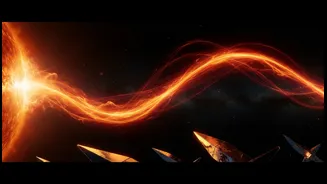
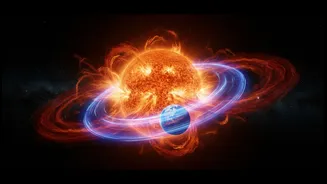
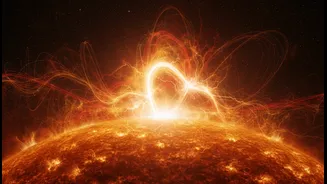
The sun is a dynamic and sometimes volatile star. Its surface is a churning mass of hot gas and complex magnetic fields. When these magnetic fields twist and snap, they can release enormous amounts of energy in two major types of events: solar flares
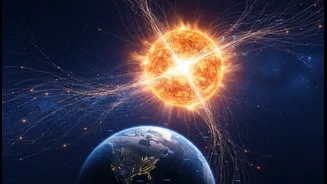
and coronal mass ejections (CMEs). A solar flare is an intense burst of radiation. Travelling at the speed of light, this radiation reaches Earth in just over eight minutes, potentially causing radio blackouts by disrupting our planet's upper atmosphere. CMEs, on the other hand, are massive eruptions of plasma and magnetic fields from the sun's outer atmosphere, the corona. These clouds of energised particles travel more slowly, taking anywhere from 15 hours to several days to cross the 150 million kilometres to Earth. When a CME slams into Earth's magnetic field, it can trigger a geomagnetic storm, threatening power grids, satellite operations, and navigation systems like GPS.
The Eyes on the Sun
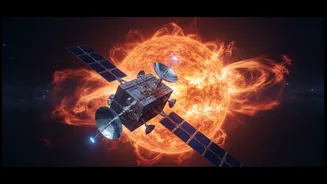
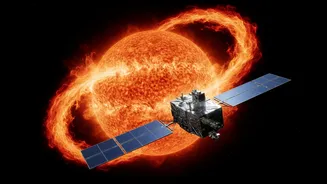
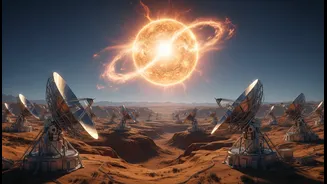
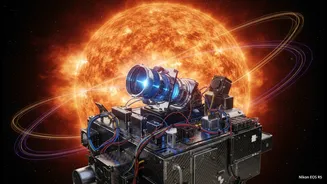
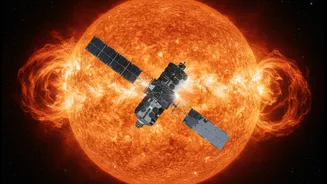
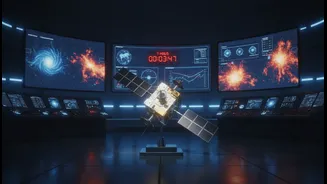
To protect ourselves, we need an early warning system. This is where a fleet of specialised space telescopes comes in. Missions like NASA's Solar Dynamics Observatory (SDO) and the joint ESA/NASA Solar and Heliospheric Observatory (SOHO) maintain a constant vigil on the sun. The SDO, for instance, captures high-resolution images of the sun in multiple wavelengths of light every few seconds. This allows scientists to see how the sun's magnetic field is behaving and to spot the tell-tale signs of an impending eruption, such as the formation of complex sunspot groups. More recently, India's Aditya-L1 mission, launched by ISRO in 2023, has taken its position at a special vantage point called Lagrange Point 1 (L1). Located about 1.5 million kilometres from Earth, Aditya-L1 has an uninterrupted view of the sun, allowing its seven instruments to study the corona and track solar wind in real-time.
From Observation to Warning
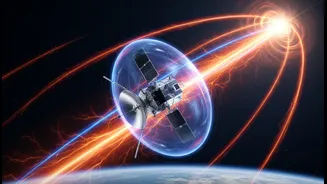
Observing a solar event is only the first step. The data collected by these space-based observatories is beamed back to Earth, where forecasters at agencies like NOAA's Space Weather Prediction Center (SWPC) in the United States analyse it around the clock. By studying the size, speed, and direction of a CME, they can run sophisticated computer models, like the WSA-Enlil model, to predict if it will hit Earth and when it will arrive. Spacecraft at the L1 point, such as Aditya-L1 and NASA's Deep Space Climate Observatory (DSCOVR), play a crucial role as tripwires. When the charged particles of a CME wash over these satellites, they provide a final, definitive warning—typically 15 to 60 minutes—before the storm hits Earth's magnetic field. This gives infrastructure operators a critical window to take protective measures.
Why This Cosmic Forecast Matters
This advanced warning, even if it's just a matter of hours or minutes, is invaluable. It allows power grid operators to re-route power and prevent cascading blackouts. Satellite operators can put their spacecraft into a protective safe mode to shield sensitive electronics from damaging radiation. Airlines can redirect flights away from polar routes, where radio communication can be disrupted and radiation exposure is higher during a solar storm. In an increasingly tech-dependent world, our ability to forecast weather in space is just as critical as predicting storms on Earth. As we continue to develop more advanced telescopes and better predictive models, we improve our chances of weathering the sun's inevitable fury, ensuring our connected world stays connected.