




A Tale of Two Timelines
On Earth, the concepts of a 'day' and a 'year' are straightforward. A day is one full rotation of our planet on its axis (about 24 hours), and a year is one full orbit around the Sun (about 365 days). This rhythm governs our lives, our seasons, and our calendars.
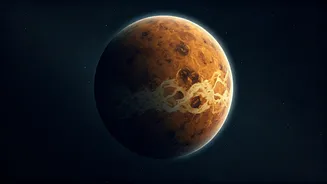
But our cosmic neighbour, Venus, plays by a completely different set of rules. For Venus, the timeline is scrambled: its year is shorter than its day. To be precise, Venus completes one orbit around the Sun in about 225 Earth days. However, it takes a staggering 243 Earth days for the planet to complete a single rotation on its axis. This means if you could stand on the blistering surface of Venus, you would see the year tick over before the planet has even finished one full spin.
Defining the Venusian Day
To understand this, we need to be clear about what we mean by a 'day.' The 243-day figure refers to Venus's sidereal day—the time it takes to rotate once relative to the distant stars. This is its true axial rotation. There's also the solar day, which is the time from one sunrise to the next. Because Venus is rotating very slowly while also orbiting the Sun, its solar day is different. In fact, a solar day on Venus is about 117 Earth days long. Still incredibly long, but the core oddity remains: its fundamental rotation period (the sidereal day) is longer than its orbital period (the year). Adding another layer of weirdness, Venus rotates 'backwards.' Unlike Earth and most other planets in our solar system, it spins in a retrograde motion, meaning the Sun would appear to rise in the west and set in the east.
The Prime Suspect: A Thick Atmosphere
So, why is Venus so slow? For decades, scientists hypothesised that a massive collision in its distant past might have knocked it off-kilter, slowing its spin and even flipping it upside down. While a cataclysmic impact is a possibility, a more recent and compelling theory points to Venus's own atmosphere. Venus is shrouded in a thick, heavy blanket of carbon dioxide, about 90 times denser than Earth's atmosphere. This crushing atmosphere is not static; it whips around the planet at high speeds, creating powerful winds and atmospheric tides. Recent models suggest that these thick, fast-moving atmospheric tides have acted like a brake over billions of years. The immense friction between the dense, circulating atmosphere and the planet's solid surface would have gradually slowed Venus's rotation to its current, leisurely pace. It's a planetary-scale example of air resistance, powerful enough to alter the fundamental rhythm of a world.
A Runaway Greenhouse Effect
This dense atmosphere is also responsible for Venus's reputation as the hottest planet in the solar system, with surface temperatures soaring to around 465°C—hot enough to melt lead. The thick clouds of sulfuric acid and the massive concentration of carbon dioxide trap the Sun's heat in an extreme, runaway greenhouse effect. This hellish environment is directly linked to the atmospheric dynamics that control its long day. The heat drives the super-rotating winds, which in turn create the friction that slows the planet's spin. The planet's climate and its rotational speed are locked in a feedback loop that has shaped Venus into the strange world we observe today. It serves as a stark reminder of how powerful a role an atmosphere can play in the evolution of a planet.